Aircon Works at Night, Struggles by Day? Brisbane Guide
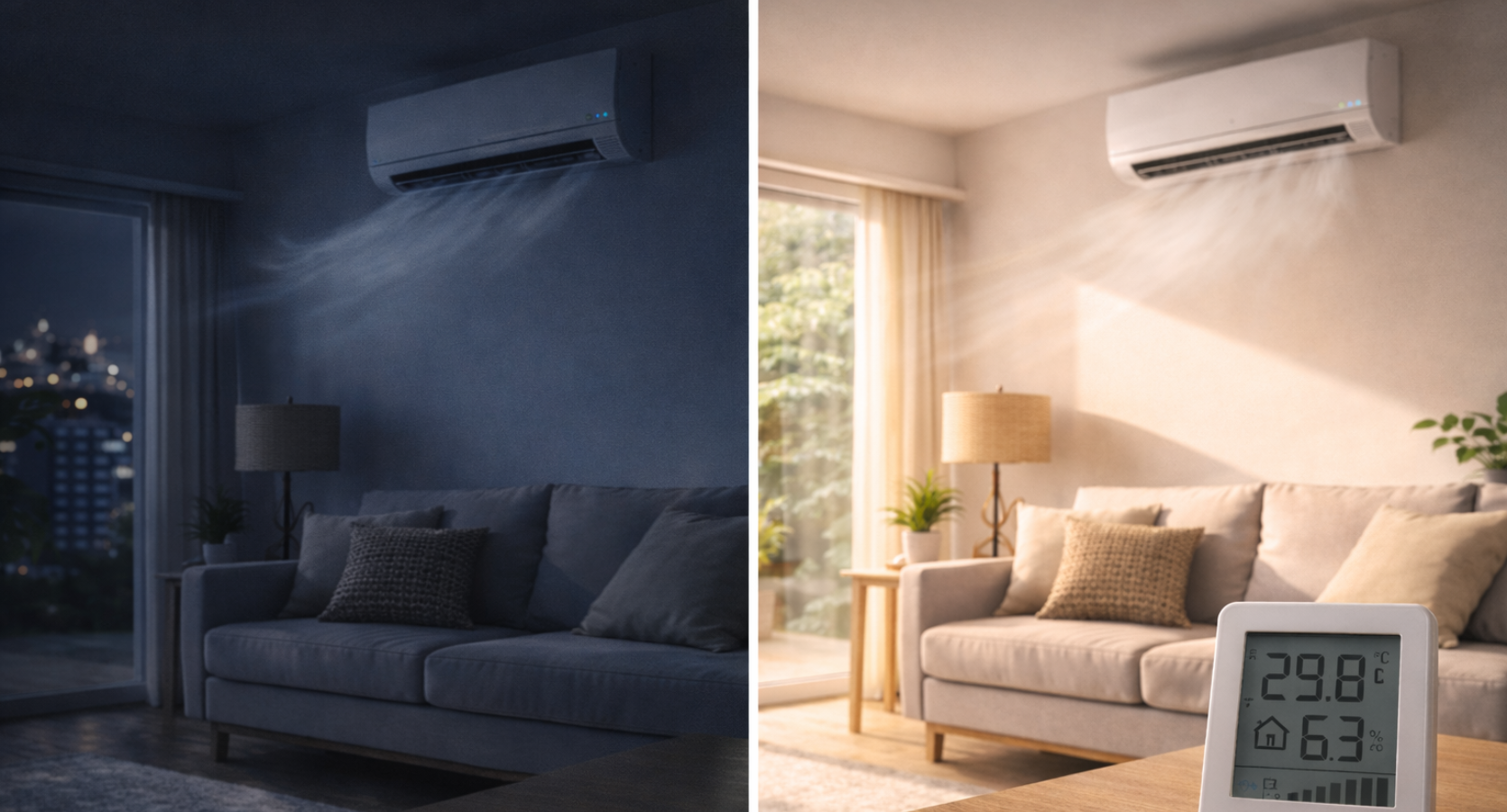
If your aircon cruises at night but lags in the Brisbane daytime, that’s not normal. Day heat, humidity, and voltage dips expose hidden faults. Here’s what’s really going on.
If your aircon (air conditioner) feels strong at night but struggles during the day, that’s not normal in Brisbane. The heat, the humidity, and the way homes heat up under our sun expose issues that don’t show after dark. Night air is cooler. Loads are lower. Margins feel fine. Daytime is a different test.
What you’re seeing is a system hitting limits. Sometimes it’s the unit. Sometimes it’s the install. Sometimes it’s power conditions across Brisbane suburbs during peak demand. We see it every summer, from Queenslanders with hot roof spaces to bayside homes with salty air on the fins. The fix starts with diagnosing the actual bottleneck. Not guesswork.
Here’s the truth:
Daytime Brisbane conditions push your aircon harder than any winter night ever will.
If it can’t reject heat, move air, or hold pressure, performance crashes when the sun is up.
This isn’t about brand loyalty. It’s about physics, install quality, and the real conditions your home faces.
1. Midday heat pushes head pressure through the roof
In Brisbane heatwaves, your outdoor unit runs into hot air and radiant sun. That drives condensing temperatures up. The compressor works harder. Current climbs. Protection devices start watching.
When the head pressure gets too high, the unit can throttle or trip to protect itself. At night, that pressure drops, so it runs fine. Nothing “fixed” itself. The load just eased.
At this point, you may see:
Long run times with poor cooling mid-afternoon
Outdoor fan loud, air off the top feels very hot
Unit cycling off on the hottest hours
Power bill creeping up with little comfort
2. Dirty or corroded outdoor coil choking heat rejection
Dust, grass clippings, and storm-season debris clog the fins. Near the bayside, salty air slowly corrodes the coil. That reduces heat transfer. Condensing pressure rises sooner in the day.
At night, cooler air masks the problem. In the sun, the weakness shows. The compressor runs near its thermal edge and may back off or trip.
At this point, you may see:
Matted fins, fluff, or grime on the coil
Hot pipework right at the outdoor unit
Short cycles on the hottest hours
Increased noise from the outdoor fan
3. Low voltage during peak demand reducing compressor torque
Across Brisbane, late-arvo peak demand can dip voltage. Compressors need torque to start and run. Low voltage means hard starts, hotter windings, and stressed contactors. Some control boards sense undervoltage and limit operation.
At night, voltage often improves. During the day, especially on heatwave afternoons, your aircon may stumble, chatter, or throw an error.
At this point, you may see:
Lights dim slightly when the aircon starts
Outdoor unit clicks but hesitates to start
Intermittent error codes during hot periods
Circuit breaker warm to touch after long runs
4. Blocked return filter or dirty indoor coil starving airflow
Low airflow is silent but deadly to performance. A clogged return filter or dusty indoor coil reduces air over the evaporator. The coil runs too cold, can ice, then the system loses capacity. At night, gentler loads hide it.
By midday, humidity and heat push it over the edge. Airflow drops further. Cooling falls off a cliff.
At his point, you may see:
Weak airflow from supply vents
Cold supply air at first, then warmer as it struggles
Occasional ice on indoor pipes or a wet drain
Longer cool-down times for the same setpoint
5. Low refrigerant charge from a slow leak
A small leak doesn’t scream on a mild night. It screams during a Brisbane scorcher. Low charge starves the evaporator, superheat climbs, and capacity falls. The compressor runs hot. Protection may intervene.
At night, it somewhat copes. During the day, the system can’t carry the load curve, so rooms never pull down.
At this point, you may see:
Thin frost on the smaller line at times
Hissing at flare joints or oil stain on fittings
Indoor unit runs but rooms don’t drop in temperature
System stops early with an error in hot periods
6. Roof space heat soak and duct losses in Queenslanders
Tin roofs and older insulation let roof spaces hit extreme temps. Warm ducts, crushed runs, or leaky returns pull hot roof air into the system. By day, supply air warms in the duct before it reaches rooms.
At night, roof temps drop and losses reduce. The system seems fine again, until the next sunny day.
At this point, you may see:
Rooms furthest from the indoor unit never cooling
Hot or dusty smell at start-up on sunny days
Visible kinks or sag in flexible duct
Return grille whistling, hinting at restrictions
7. Outdoor unit placement and sun exposure
Units jammed into tight corners, caged in with poor clearance, or copping full west sun recirculate their own hot air. That spikes head pressure. Add a fence, pool pump heat, or bins blocking flow, and it’s worse.
At night, ambient falls and the unit breathes. In the day, it chokes.
At this point, you may see:
Outdoor aircon too close to walls or plants
Very hot air blowing straight back toward the coil
Unit shuts down in direct sun, restarts later
Paint fading or UV damage on the top cover
Is This Normal?
Some performance drop in a Brisbane heatwave is normal. Physics wins.
But long run times with little cooling aren’t normal.
A unit that trips, errors, or clicks off in the heat has a fault or install issue.
If humidity climbs indoors while the aircon runs, something’s off.
If voltage dips make lights flicker when it starts, that’s a supply problem worth checking.
Bayside corrosion and storm-season debris accelerate issues but shouldn’t cripple a healthy system.
A well-sized, well-installed aircon should still keep a Brisbane home comfortable in the day.
If yours can’t, it needs a proper diagnosis.
When You Should Call an Electrician
You don’t need to wait for a total failure. The best time is when the symptom appears in daylight. That’s when we can capture live readings under load and find the bottleneck quickly. Call if you notice:
Circuit breaker or safety switch tripping during hot afternoons
Outdoor unit hot to touch, loud, or clicking without starting
Ice on pipes, water drips from the indoor unit, or musty smell
Error codes that only appear in the middle of the day
Burning smells, obvious arcing, or melted insulation are urgent. Turn the aircon off at the switchboard and call. If you’re near the bayside or in an older Queenslander, don’t wait for the next heatwave. Small faults grow fast in our conditions. Getting ahead of summer can save the compressor, ducts, and your power bill.
Night-time performance can be deceptive. Day heat, humidity, and peak-demand voltage in Brisbane expose the real health of your aircon and installation. High head pressure, low airflow, poor ducting, low charge, and sun-baked outdoor units are the usual suspects. None of these fix themselves. They just show up less at night.
A clean, correctly charged system with good airflow and proper placement handles Brisbane days. If yours doesn’t, there’s a reason, and it can be found. Start with facts, not settings. Measure, test, and adjust the system to the conditions it actually faces outside your window.
Need it sorted properly? Book a daytime diagnostic with Exclusive Electrical & Air. We test under load, check voltage, pressures, airflow, and the install itself across all Brisbane suburbs. We’ll pinpoint the bottleneck and recommend the safest, smartest next step.
Call now to secure a slot during daylight hours.
Serving all Brisbane homes, from Queenslanders to bayside builds.