Can Your Electrician Install Security Cameras? (Yes, Here's Why That Matters)
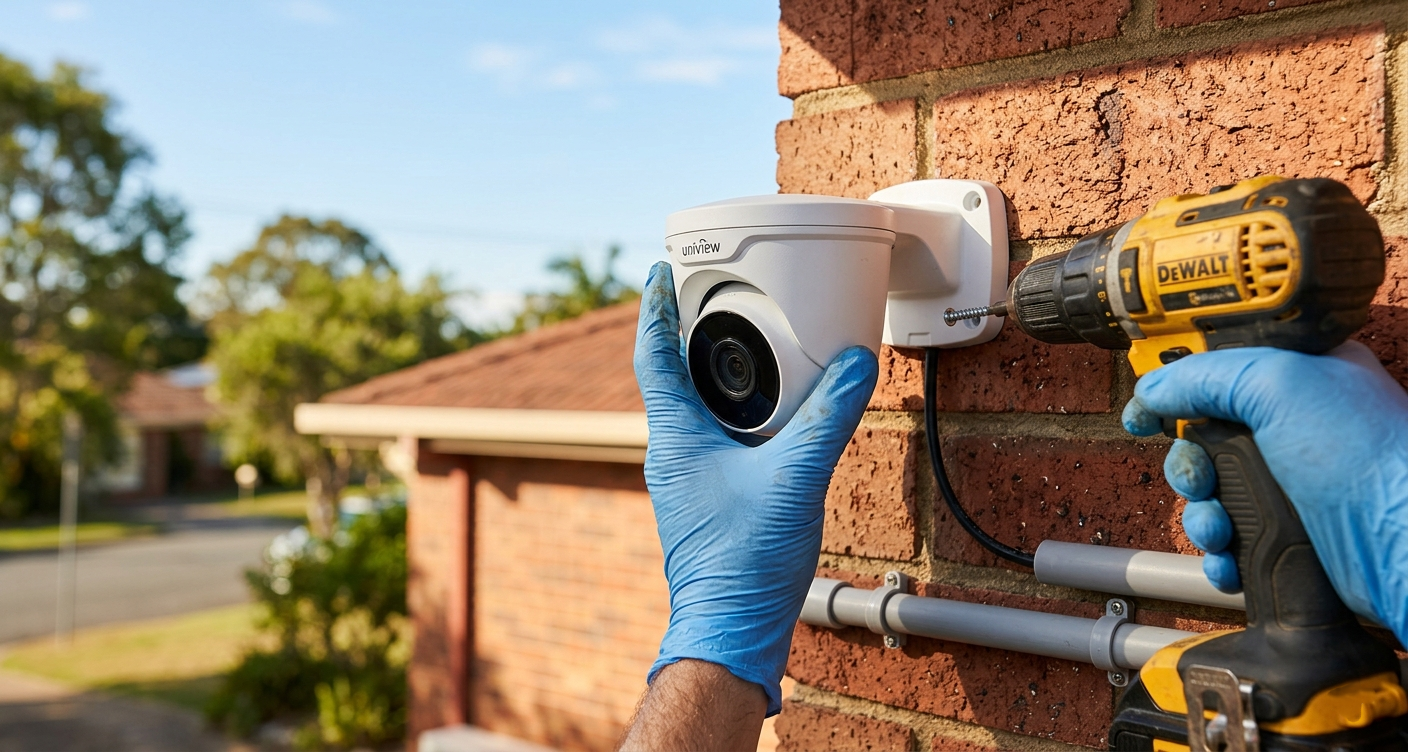
Most Brisbane homeowners call a security company for CCTV — and end up with electrical work that a licensed electrician never touched. Under Queensland's Electrical Safety Act 2002, all electrical components of a CCTV installation legally require a licensed electrician. Here's why that matters, what can go wrong when it doesn't happen, and what to ask before you book.
CCTV Installation Brisbane: Why Your Electrician Wins
Last month, we were called to a home in Kenmore where a security company had installed four cameras six weeks earlier. The owner was happy with the cameras. Less happy about the main switchboard tripping every few days — and completely in the dark about why.
The cause was straightforward: the power connections for the cameras had been run off an already-loaded circuit by someone without an electrical licence, using cable that wasn't rated for the load. A twenty-minute job to fix the wiring had become a call-out, a diagnosis, a partial rewire, and an awkward conversation about what the original installer should have done.
This isn't a rare story. It's one of the more common calls we take on CCTV work across Brisbane.
Can an Electrician Install Security Cameras in Queensland?
Yes — and for most Brisbane residential and commercial installations, a licensed electrician is the better choice. Under Queensland law, any electrical work on a property must be performed by a licensed electrician. For CCTV installation, that means every camera power connection, circuit run, and switchboard integration must have a licensed electrician involved. Many licensed electricians — including our team at Exclusive Electrical & Air — handle the complete installation: cabling, power, camera positioning, and system configuration, all under one licence.
Why the Electrical Side of CCTV Gets Ignored — Until It Fails
A security camera system is, at its core, an electrical and data infrastructure project. Cameras need power. Cables need to run through wall cavities, ceiling spaces, and external conduits. Recording units — specifically NVRs (Network Video Recorders, the units that store all camera footage) — need dedicated, correctly loaded power connections. And in a professionally installed wired system, every part of that infrastructure needs to meet Queensland's electrical standards.
The camera hardware is only one part of the equation. How cables are routed, how power is delivered, how connections are weatherproofed, and how the system integrates with your home's existing wiring — that's what determines whether your system runs reliably for a decade or starts causing problems within weeks.
This is exactly where a non-licensed installer falls short. Not because they don't know cameras — but because they're not qualified to assess or work on the electrical infrastructure the cameras depend on.
Common problems we've remediated across suburbs like Aspley, Chermside, and The Gap include:
Overloaded circuits caused by piggy-backing camera power off existing household circuits
Non-compliant cable runs through fire-rated wall cavities — a building code issue, not just an electrical one
Exposed or underrated connections at outdoor camera locations, particularly in Queensland's storm and humidity conditions where weatherproofing is non-negotiable
PoE injectors (Power over Ethernet devices that send both power and data through a single cable) installed on circuits they weren't sized for, causing nuisance tripping or hardware damage
None of these issues are visible until something goes wrong. At that point, the cost of fixing them typically exceeds what proper installation would have cost in the first place.
What Queensland Law Actually Requires
Under the Electrical Safety Act 2002 (Qld), all electrical work on a residential or commercial property must be performed by a licensed electrical contractor. This isn't a grey area — it's a safety standard with real enforcement behind it.
For CCTV installation in Brisbane, the electrical work component includes:
Running and connecting power to hardwired cameras
Installing dedicated circuits or GPOs (General Purpose Outlets — standard power points) to power NVR units
Any work inside or connected to a switchboard or distribution board
Cable management that penetrates walls, ceilings, or external building fabric in a way that affects electrical integrity
Installations must also comply with AS/NZS 3000 — the Australian and New Zealand Wiring Rules that govern how all electrical work is designed and executed — and be covered by a Certificate of Testing and Compliance (CTC), the official Queensland electrical safety record that verifies the work was done correctly and to code.
A security technician without an electrical licence can legally handle camera hardware, configuration, and data cabling in Queensland. They cannot legally carry out the electrical work. In practice, this means installations by non-licensed security companies often leave electrical work undone, use workarounds that don't meet the standard, or subcontract a separate electrician — adding cost, coordination delays, and accountability gaps to the job.
For licensing verification, you can check any electrical contractor's credentials through the Queensland Building and Construction Commission (QBCC) licence register, or confirm electrical safety requirements through the Electrical Safety Office Queensland.
A licensed electrician who also handles CCTV installations completes the entire job under one licence, one standard, and one compliance record.
Ready to get your CCTV installed properly, first time? 📞 Call Exclusive Electrical & Air: +61 468 813 833 | Book Your On-Site CCTV Assessment →
The Practical Advantages of Using a Licensed Electrician for CCTV
Cable Runs Done Properly
Running cables through an existing Brisbane home is one of the most skill-dependent parts of any CCTV installation. Older Queenslanders in suburbs like Mitchelton and The Gap present completely different challenges to the brick veneer homes common across Chermside and Aspley — or the contemporary builds you'll find in newer pockets of St Lucia and Kenmore.
Doing it well means working within the structure of a home without causing damage, without creating future access problems, and without leaving exposed cable runs that compromise the look of the property. This is baseline work for a residential electrician. It's the same skill set used when running new circuits, installing downlights, or upgrading switchboards.
Integration With Existing Electrical Infrastructure
A properly installed CCTV system is integrated with the home's electrical infrastructure — not bolted onto it. That means dedicated circuits where appropriate, correctly rated cabling throughout, weatherproof connections at all external camera locations, and NVR installation that doesn't create overloading or safety risks.
An electrician assessing a property for CCTV is also positioned to identify existing electrical issues that would affect the system's performance — something a non-electrical security technician simply isn't qualified to evaluate.
Single Point of Accountability
When a licensed electrician installs your CCTV system, every component of the job falls under one licence and one warranty. If something goes wrong, there's one call to make and one professional accountable.
When a security company handles cameras and a separate electrician handles power, accountability for anything that sits at the intersection of the two becomes a conversation between two businesses — with the homeowner caught in the middle.
What a Typical Brisbane CCTV Installation Looks Like
Most homeowners want to know what they're signing up for before they book. Here's a realistic picture of what a professional CCTV installation in Brisbane involves:
Assessment (Day 1 or pre-install visit): We walk your property, identify coverage blind spots, assess cable run options, and check your existing electrical infrastructure. You get a quote that covers everything — cameras, cabling, NVR, and installation — before any work starts.
Installation (typically half a day to a full day for a 4–8 camera system): Cameras are positioned and mounted. Cables are run through wall cavities and roof space where possible, keeping exposed runs to a minimum. The NVR is installed and connected. Power is run from an appropriate circuit. The system is configured, tested, and handed over with a walkthrough.
Compliance documentation: You receive a Certificate of Testing and Compliance for all electrical work carried out — the official record that the installation meets Queensland's electrical safety standards.
For most suburban Brisbane homes, a 4-camera wired NVR system covering the front entry, driveway, back door, and a side access point is the most common starting point. Larger properties or those with specific coverage requirements are assessed individually.
What to Look For When Choosing a CCTV Installer
Not every electrician installs security cameras, and not every security company employs licensed electricians. These questions, asked directly before you book, will tell you everything you need to know:
Are you a licensed electrician, and can you show your Queensland electrical contractor licence?
Do you carry out the full installation — cable runs, power connections, and camera setup — or do you subcontract the electrical work?
What types of systems do you install? Do you work with wired NVR systems, wireless setups, or both?
Can you provide references or examples of residential CCTV installations completed in Brisbane?
What warranty do you offer on both equipment and installation workmanship?
Will the electrical work be covered by a Certificate of Testing and Compliance?
An installer who answers all of those clearly and confidently is in a fundamentally different category from one who becomes vague when the licensing question comes up.
Get a straight answer and a fixed price before anyone turns up to your property. 📞 Call +61 468 813 833 | Book Your On-Site CCTV Assessment →
Commercial CCTV Installation in Brisbane
The residential rules apply equally to commercial — but the stakes are higher and the scope is broader.
Brisbane businesses — whether you're running a retail tenancy in the Indooroopilly shopping precinct, managing a warehouse in the Hamilton industrial zone, operating professional offices in Toowong, or overseeing a body corporate building in the inner suburbs — face CCTV installation requirements that go well beyond a standard four-camera home setup.
Commercial CCTV installations typically involve:
Higher camera counts across larger footprints, including car parks, loading docks, entry points, server rooms, and cash handling areas
Multi-NVR or server-based recording systems with extended retention periods (particularly important for insurance and legal compliance)
Integration with existing access control or alarm systems — which requires careful coordination between electrical, data, and security trades
Body corporate compliance — including notification and privacy obligations under Queensland's surveillance laws when cameras cover common areas or neighbouring properties
Outdoor and car park installations that must meet IP (Ingress Protection) weatherproofing ratings appropriate for Queensland's storm season
For commercial clients in the Hamilton and Toowong business districts — where high-value stock, after-hours access, and insurance requirements all create specific demands — a licensed electrician with commercial CCTV experience brings something a residential-only security company doesn't: the ability to assess and integrate with the full electrical infrastructure of the building.
We work with commercial clients across Brisbane's inner and outer business zones. If you're managing a multi-tenancy property, a retail strip, or a warehouse and haven't reviewed your CCTV coverage recently, it's worth a conversation.
Where Specialist Security Companies Still Make Sense
For large-scale enterprise installations — integrated access control across multi-building campuses, government or healthcare facilities with specialist compliance requirements, or complex alarm system integrations — a security integrator with deep experience in those specific systems is genuinely the right call.
But that describes a very small percentage of Brisbane CCTV jobs.
For the vast majority — a residential home, a small commercial tenancy, a body corporate building, or a warehouse that needs reliable coverage and legally compliant installation — a licensed electrician who handles CCTV regularly is better positioned to deliver a complete, compliant result with fewer moving parts.
The distinction worth drawing is between a security company that employs licensed electricians and one that doesn't. The former can deliver a complete job. The latter cannot, regardless of how good their cameras are.
About Exclusive Electrical & Air
We're a licensed Queensland electrical contractor with over 10 years of experience and more than 2,000 customers served across Brisbane — residential and commercial. Our team carries out CCTV installations as part of a broader electrical service offering that includes Switchboard Upgrades, Solar Panel Installation, Smoke Alarm Compliance, and full residential and commercial electrical work.
Every CCTV installation we carry out is completed under our electrical contractor licence, covered by a Certificate of Testing and Compliance, and backed by a workmanship warranty.
We service all Brisbane suburbs — including Chermside, Aspley, Hamilton, Kenmore, Mitchelton, Indooroopilly, The Gap, St Lucia, Toowong, and everywhere in between.
Frequently Asked Questions
Can a licensed electrician legally install security cameras in Queensland? Yes. A licensed electrician can legally carry out the full scope of a residential or commercial CCTV installation in Brisbane, including all electrical work, cable runs, and camera installation. Any electrical component of a CCTV job — including powering cameras and connecting NVR units — legally requires a licensed electrician under the Electrical Safety Act 2002 (Qld). Many experienced electricians, including our team, also handle camera configuration and system setup as part of the same service. Learn more about our CCTV installation service →
Does a security camera installer need to be a licensed electrician in Queensland? For the electrical work component, yes. A security technician without an electrical licence can handle camera hardware and data cabling, but cannot legally carry out electrical work — including connecting power to cameras or working on circuits. Any installation involving electrical work must have a licensed electrician involved and be covered by a Certificate of Testing and Compliance.
Is it cheaper to use an electrician or a security company for CCTV installation? It depends on the provider, but using a licensed electrician who handles CCTV regularly often eliminates the cost of subcontracting the electrical work separately — making the total job price more competitive. Get comparable quotes from both for the same scope. Make sure any quote from a security company includes the cost of the licensed electrician they'll need to engage. Get a quote from our Brisbane team →
What kind of security camera systems do electricians install? Licensed electricians who carry out CCTV installations typically work with wired NVR systems using IP cameras — the standard for professional residential and commercial installations. Many also work with wireless systems and hybrid setups. Confirm the range of systems an installer handles before booking.
What happens if electrical work on a CCTV installation is done without a licence in Queensland? Unlicensed electrical work in Queensland is illegal. Consequences include safety risks, voided home insurance, potential personal liability if something goes wrong, and the cost of having a licensed electrician redo the work to a compliant standard. All electrical work on a property must be carried out by a licensed electrician and covered by a Certificate of Testing and Compliance.
Should I get a separate electrician and security company, or use one provider? Where possible, a single provider who is both a licensed electrician and experienced in CCTV installation is the cleaner, lower-risk choice. It simplifies accountability, removes the cost and coordination of separate trades, and produces a more consistent installation outcome covered by one warranty. See how we handle the full installation →
Book Your CCTV Assessment Across Brisbane
At Exclusive Electrical & Air, we're licensed electricians who carry out CCTV installation across all Brisbane suburbs — from Aspley and Chermside in the north to Kenmore and Indooroopilly in the west.
We'll walk your property, identify coverage blind spots, check your existing electrical infrastructure, and quote on the spot — with a fixed price that covers cameras, cabling, NVR, and installation, all under our Queensland electrical contractor licence.
📞 Call us: +61 468 813 833 | Book Your On-Site CCTV Assessment →
10+ years experience. 2,000+ Brisbane customers. Licensed Queensland Electrical Contractor. Workmanship warranty on every installation.