Can a Ceiling Fan Replace an Air Conditioner in Brisbane? (Honest Answer)
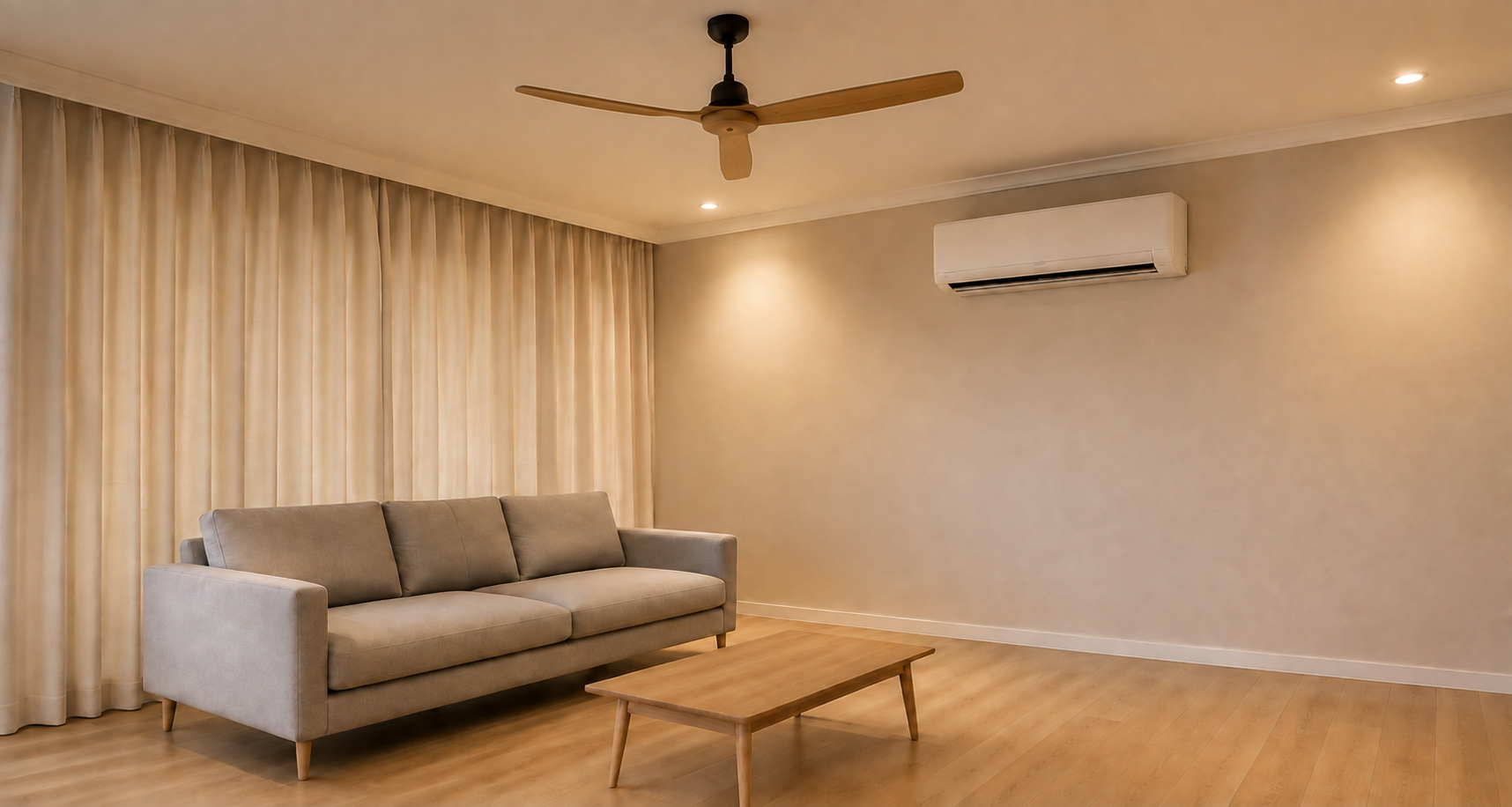
The honest answer is no, not during a Brisbane summer. But that is not the full picture. Ceiling fans do a specific and useful job, and understanding exactly what that job is determines whether one is the right solution for your situation or whether air conditioning is the only realistic option for the months that matter most.
Can a Ceiling Fan Replace an Air Conditioner in Brisbane? (Honest Answer)
Every Brisbane summer, the same question gets asked by homeowners looking at their power bills and wondering whether there is a cheaper way to stay comfortable. A ceiling fan uses a fraction of the electricity an air conditioner does. It is quieter, simpler, and considerably less expensive to install. So why isn't everyone using one instead of running the split system all day?
The answer comes down to what a ceiling fan actually does and what Brisbane's climate actually demands, and the two do not always align in the way homeowners hope. This is not a blog that will tell you ceiling fans are useless, because they are not. But it is one that will tell you the truth about where their limitations become genuinely relevant in South East Queensland's summer conditions, and what the most practical approach looks like for a Brisbane household trying to manage comfort and energy costs at the same time.
A common approach worth aiming for: a household in a suburb like St Lucia running ceiling fans through the shoulder seasons, September through to about April excluding the peak of summer, and reserving air conditioning specifically for the genuinely hot, humid stretch. Same comfort level most of the year, meaningfully less energy spent getting there.
Exclusive Electrical & Air installs both ceiling fans and air conditioning systems across Brisbane for residential and commercial customers, with over a decade of experience and more than 2,000 customers served in suburbs including Kenmore, The Gap, Chermside, Hamilton, and St Lucia. Rated 5 stars on Google. 📞 0468 813 833.
What a Ceiling Fan Actually Does
This is the foundation of the whole conversation, and it is where most misconceptions originate. A ceiling fan does not cool a room. It does not lower the air temperature by a single degree. What it does is move air across the occupants of the room, and that moving air accelerates the evaporation of moisture from skin, which creates a wind chill effect that makes the body feel cooler even though the ambient temperature is unchanged.
The practical result of that wind chill effect is that a person sitting in a room with a ceiling fan operating can feel roughly three to four degrees Celsius cooler than they would in the same room with still air at the same temperature. That is a meaningful difference in comfortable conditions. It becomes a much less meaningful difference when the ambient temperature is 34 degrees and the humidity is sitting at 75 percent.
The critical variable is humidity. The wind chill effect works because moving air helps sweat evaporate from the skin. When the air is already heavily saturated with moisture, as it regularly is in Brisbane during storm season and the peak summer months, that evaporation is significantly impaired. A ceiling fan in a humid 34-degree room is moving hot, moist air across your skin. It helps. But it does not come close to replicating what a reverse-cycle air conditioning system does by actively removing heat and humidity from the room's air volume. See the Bureau of Meteorology Queensland climate data.
Brisbane's Climate and Why It Matters Here More Than Most Places
Brisbane's summer climate is characterised by two conditions that together define the ceiling fan's limitations in this specific city: high temperatures and high humidity. Inland cities like Melbourne and Adelaide experience high summer temperatures but with comparatively lower humidity, which makes fan-based comfort more effective across a broader range of conditions. Brisbane's proximity to the coast and its sub-tropical climate mean summer heat regularly arrives with humidity levels that substantially reduce the effectiveness of any cooling method that relies on evaporation.
Between November and February, Brisbane regularly experiences days where the temperature exceeds 30 degrees and relative humidity sits above 70 percent. On those days, a ceiling fan is managing discomfort at best. For households with young children, elderly residents, or people with health conditions that affect heat tolerance, managing discomfort is not an adequate outcome.
This is not a marginal difference. It is the reason air conditioning penetration in Queensland households is among the highest in Australia, and it is the honest context within which any comparison between ceiling fans and air conditioners in Brisbane needs to be made.
Where Ceiling Fans Genuinely Excel in a Brisbane Home
None of the above means ceiling fans are without value in Brisbane. They are genuinely useful in the right conditions and in the right role, and dismissing them entirely misses the practical and financial case for including them in a well-considered home cooling strategy.
Shoulder seasons are where a ceiling fan earns its place most clearly. Brisbane's spring and autumn conditions, particularly the months of September, October, March, and April, regularly produce days where temperatures sit in the mid-to-high twenties with moderate humidity. On those days, a ceiling fan is often entirely sufficient to maintain comfort without any air conditioning use at all. A household that runs ceiling fans through the shoulder seasons and reserves air conditioning for peak summer conditions can make a meaningful reduction in annual cooling costs.
Overnight comfort in the milder parts of the year is another area where ceiling fans perform well. Brisbane nights cool considerably in spring and autumn, and a ceiling fan set to a low speed provides enough air movement for comfortable sleep without the noise, energy draw, or dry-air effects of air conditioning.
In combination with air conditioning, ceiling fans deliver their most practical value in Brisbane's peak summer conditions. A split system running at a slightly higher thermostat setting with a ceiling fan operating can produce a similar perceived comfort level to a lower thermostat setting without a fan. Each degree of thermostat increase typically reduces air conditioning energy consumption by roughly one to three percent, so a fan-assisted couple of degrees adds up to a genuine, if modest, saving over a full cooling season. A ceiling fan that costs pennies per hour to run and allows the air conditioner to work a little less hard is not an alternative to air conditioning. It is a cost-effective complement to it. See the Queensland Government energy efficiency resources.
Wondering whether your home would benefit more from added ceiling fans, an air conditioning upgrade, or both working together? A site assessment settles it based on your actual rooms and usage, not a generic rule of thumb. 📞 0468 813 833 | Book Your cooling assessment.
Ceiling Fan Installation: What Is Involved
A ceiling fan installation is notifiable electrical work in Queensland where it involves a new wiring circuit or connection to a lighting circuit, and must be carried out by a licensed electrician under the Electrical Safety Act 2002 QLD. This includes the vast majority of new ceiling fan installations in existing Brisbane homes, where a new ceiling outlet or circuit connection is required.
The installation process involves assessing the ceiling structure for appropriate mounting, running or connecting wiring to the fan location, installing the mounting bracket and fan assembly, and confirming correct operation. For rooms without an existing ceiling outlet, additional wiring work is required. Your licensed electrician can assess the specific requirements for each room during a site visit. See our electrical installations Brisbane service page.
Modern ceiling fans include DC motor technology that draws significantly less power than older AC motor fans, with quality DC ceiling fans consuming as little as 15 to 35 watts at typical operating speeds. Selecting a quality DC motor fan for each room maximises the energy efficiency benefit and reduces the running cost difference between fan and air conditioning operation even further.
The Practical Verdict for Brisbane Households
A ceiling fan cannot replace an air conditioner in Brisbane during peak summer conditions. On high-temperature, high-humidity days, which describe a significant proportion of Brisbane's summer, a ceiling fan alone will not maintain acceptable comfort for most occupants.
What a ceiling fan can do is extend the period during which air conditioning is unnecessary, take a little of the load off air conditioning when both are used together, and provide a comfortable and economical solution through Brisbane's shoulder seasons. That is a genuine and financially worthwhile contribution to a household's cooling strategy, even if it falls well short of replacing the split system during the months that matter most.
FAQ
Q: How many ceiling fans would I need to replace an air conditioner in a Brisbane living room?
A: No number of ceiling fans can replicate what an air conditioner does, because the two systems work differently. An air conditioner removes heat and humidity from the room's air volume. Ceiling fans move air across occupants without changing air temperature or humidity. In Brisbane's summer conditions, additional fans increase air movement but do not address the underlying temperature and humidity levels.
Q: Does running a ceiling fan and air conditioner together actually save money?
A: Yes, to a meaningful degree. Running a ceiling fan alongside the air conditioner allows the thermostat to be set a degree or two higher while maintaining a similar perceived comfort level. With each degree of setpoint increase typically reducing energy consumption by roughly one to three percent, the combined running cost of fan and air conditioner is often lower over a season than the air conditioner alone at a lower thermostat setting.
Q: Can I install a ceiling fan myself in Queensland?
A: Installing a ceiling fan that requires any electrical connection or wiring work must be carried out by a licensed electrician under Queensland electrical safety legislation. Plug-in fans that connect via a standard power point require no installation work. For any fan that hardwires into the ceiling, a licensed electrician is required.
Q: What size ceiling fan do I need for a Brisbane living room?
A: Fan blade span is the primary sizing factor. A room up to approximately 15 square metres is typically served by a fan with a 900 to 1,200 millimetre blade span. Larger rooms benefit from a 1,200 to 1,500 millimetre span or multiple fans. A licensed electrician can advise on appropriate sizing and positioning during a site assessment.
Q: Should I run my ceiling fan in reverse during winter?
A: Most ceiling fans include a reverse rotation setting that pushes warm air that has risen to the ceiling back down into the room. In Brisbane's mild winters this effect is modest, but in rooms with high ceilings it can contribute to more even temperature distribution and reduce the load on any heating in use.
Still weighing up ceiling fans, air con, or both for your place? Happy to talk through what makes sense room by room. 📞 0468 813 833 | Book Your cooling assessment.
If your Brisbane home needs ceiling fans installed, air conditioning assessed, or both, Exclusive Electrical & Air can help you work out the right combination for your specific rooms and usage patterns.
The team carries out ceiling fan installations and air conditioning assessments across all Brisbane suburbs, including Kenmore, Toowong, Chermside, Hamilton, and Indooroopilly. All work is performed by licensed electricians and backed by a workmanship warranty. Rated 5 stars on Google. 10+ years experience. 2,000+ Brisbane customers. Licensed Queensland Electrical Contractor.
Call 0468 813 833 or book online at https://www.exclusiveqld.com.au/connect to arrange an assessment for your property.