How to Charge Your EV Using Solar Power at Home in Brisbane
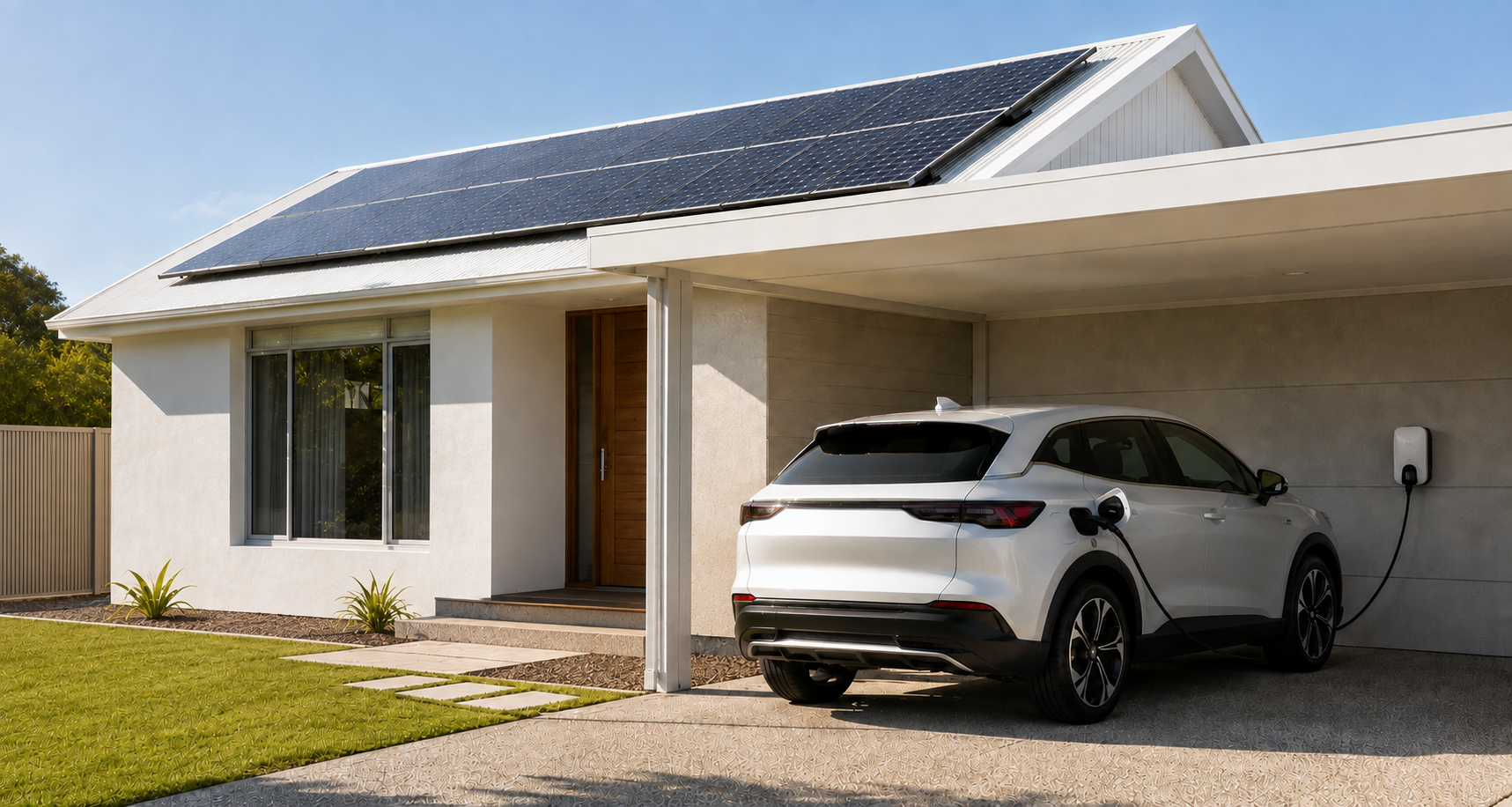
Brisbane gets more solar resource than almost any comparable city in the world, and an EV sitting in the garage during the day is one of the most practical uses for the electricity your roof is generating. Here is how solar EV charging actually works and what your setup needs to make it happen.
How to Charge Your EV Using Solar Power at Home in Brisbane
Brisbane is one of the best-placed cities in the world for residential solar generation. High annual sunshine hours, a well-established solar industry, and strong grid-connected infrastructure mean a quality solar system on a Brisbane home generates meaningful electricity across every month of the year, not just the peak of summer. For households that have also made the move to an electric vehicle, that generation capacity represents a genuinely significant opportunity to offset or eliminate the cost of home charging.
The concept is straightforward. Your solar panels generate electricity during daylight hours. Under normal operation, any generation that exceeds your home's immediate consumption is exported to the grid and earns a feed-in credit at your retailer's applicable rate. A smart EV charger changes that equation by detecting available solar export and directing it to your vehicle instead of sending it to the grid, turning energy that was earning a modest feed-in credit into kilometres in your battery at a substantially better effective rate.
A common version of this in practice: a household in a suburb like Chermside with a 6.6kW system covering a typical daily commute finds that simply scheduling the wallbox to charge during the middle of the day, rather than plugging in overnight out of habit, covers most of that commute on generation that would otherwise have been exported at a low feed-in rate. No special equipment required for that version, just a change in when the car gets plugged in.
Exclusive Electrical & Air is a Clean Energy Council accredited solar installer serving Brisbane homeowners across suburbs including Kenmore, Hamilton, Toowong, Chermside, and Indooroopilly, with over a decade of experience, more than 2,000 residential and commercial customers, and a 5 star rating on Google. The intersection of solar installation and EV charger installation is an increasingly common conversation with Brisbane households, and the following covers how the two systems work together, what equipment is involved, and what the setup realistically delivers. 📞 0468 813 833.
Why Brisbane Is Particularly Well-Suited to Solar EV Charging
The economics of solar EV charging depend heavily on how much generation is available during hours when the vehicle can be charged. Brisbane's solar resource makes this calculation consistently favourable.
South East Queensland's daily solar irradiance figures are among the highest of any Australian capital city region. A well-oriented 6.6 kilowatt solar system on a Brisbane home, a common residential system size, generates roughly 25 to 30 kilowatt-hours on a clear summer day and roughly 18 to 22 kilowatt-hours on a typical winter day. For context, a mid-sized EV consuming approximately 18 kilowatt-hours per 100 kilometres uses around 9 kilowatt-hours to cover 50 kilometres. In straightforward terms, a standard Brisbane residential solar system generates enough electricity on most days to cover a typical household's daily EV charging requirement with generation to spare, provided the charging can be scheduled to align with solar production hours. See the Bureau of Meteorology solar resource data.
That alignment is the key variable, and it is what smart EV charging equipment is specifically designed to manage.
How Solar EV Charging Actually Works
There are two approaches to charging an EV from solar at home, and they operate differently in terms of equipment requirements and the degree of solar utilisation they achieve.
Scheduled charging is the simpler approach. If your daily routine allows the vehicle to be connected and available for charging during peak solar generation hours, typically between 9am and 3pm, you can schedule your wallbox to charge during that window regardless of whether a smart charger is involved. This captures solar generation opportunistically and reduces grid draw during the charging period. It does not actively track solar generation in real time, so it does not adjust automatically if the day is partly cloudy or if household load fluctuates.
Solar diversion charging is the more sophisticated and efficient approach. A smart wallbox with solar diversion capability communicates with your home's energy monitoring system or solar inverter to track available solar export in real time. When export exceeds a configured minimum threshold, the charger begins drawing that surplus into the vehicle. As generation increases, the charge rate increases. As clouds reduce output or household consumption rises, the charge rate adjusts downward. The result is that the vehicle charges primarily on solar generation that would otherwise have been exported at feed-in tariff rates, maximising the value of your solar system for transport energy.
This functionality requires a compatible combination of smart wallbox, solar inverter, and in some cases a home energy monitoring device. Compatibility between these components is confirmed by your licensed electrician during installation planning.
What Equipment Your Setup Needs
A functional solar EV charging arrangement at a Brisbane home requires several components working together correctly.
A grid-connected solar system is the foundation. An existing system sized adequately for both household consumption and EV charging is what most Brisbane households with solar already have. Older solar systems installed at smaller capacities may benefit from an assessment to determine whether additional panels are worthwhile given the additional EV load. See our solar panel installation Brisbane service page.
A smart wallbox charger with solar integration capability is the second core component. Not all wallbox units support solar diversion, and those that do typically communicate via a current transformer clamp at the meter board or directly via the inverter's API where supported. Selecting a wallbox compatible with your existing inverter brand is a step your licensed electrician can guide you through before any equipment is purchased.
A dedicated 32-amp EV charging circuit is required regardless of the charging approach, and the switchboard needs to have the capacity to support it. That's assessed by a licensed electrician before installation, a process covered in more detail in our switchboard-and-EV-charger guide. Every EV charger installation is notifiable electrical work resulting in a Certificate of Testing and Compliance upon completion, a document worth keeping with your property records.
Not sure whether your existing system and switchboard are ready for solar EV charging? A combined assessment gives you a straight answer and a fixed-price quote. 📞 0468 813 833 | Book Your solar and EV assessment.
Battery Storage and EV Charging: The Next Step
For Brisbane households with a battery storage system alongside solar, the solar EV charging equation extends further. Surplus generation stored in a home battery during the day can be used to charge the vehicle in the evening, extending the effective solar charging window beyond daylight hours. This arrangement suits households where the vehicle isn't available during peak generation hours, such as where the car is at a workplace during the day.
Battery storage also provides a buffer against variability in generation. A partly cloudy day that reduces direct solar EV charging can still contribute meaningfully to the battery, which then supports charging after the vehicle arrives home in the evening.
The interaction between solar, battery, and EV charger systems requires careful configuration to ensure each system draws and stores energy in the correct priority order. This should be handled by an accredited installer with experience across all three system types. See the Clean Energy Council accredited installers directory.
What Solar EV Charging Realistically Saves
The saving from charging an EV on solar rather than grid electricity depends on your solar system's generation, your vehicle's consumption, your grid electricity rate, and your retailer's feed-in tariff. In Brisbane, where grid electricity rates typically sit in the 25 to 35 cents per kilowatt-hour range and feed-in tariffs are considerably lower, the difference between charging from grid electricity and charging from solar export is meaningful per kilowatt-hour.
For a household covering 15,000 kilometres per year in an EV consuming approximately 18 kilowatt-hours per 100 kilometres, the annual charging energy requirement is around 2,700 kilowatt-hours. The cost difference between sourcing that energy from the grid versus from solar generation that would otherwise earn a feed-in credit represents a genuine annual saving that compounds over the life of the vehicle.
Curious what this looks like for your own household and system size? A licensed electrician can walk through the numbers for your specific setup rather than a general estimate. 📞 0468 813 833 | Book Your solar and EV assessment.
FAQ
Q: Does my solar system need to be a certain size to charge an EV effectively in Brisbane?
A: There is no strict minimum, but a system that is already meeting most of your household consumption during the day has limited export available for vehicle charging. A 6.6 kilowatt system or larger typically generates enough surplus on most Brisbane days to cover average daily EV energy requirements. A solar assessment can determine whether your existing system is appropriately sized for the combined load.
Q: Can I charge my EV from solar overnight using a battery system?
A: Yes, provided your battery system has sufficient capacity to store the required energy during the day and your charger and battery inverter are configured to support evening discharge for EV charging. This requires compatible equipment and correct system configuration, which your licensed electrician and accredited solar installer confirm during the installation process.
Q: Will adding EV charging to my solar system affect my feed-in credits?
A: Solar energy directed to your EV via a smart charger is consumed on-site rather than exported, so it does not generate a feed-in credit for that portion. However, the effective value of that energy is higher than the feed-in rate because it displaces grid electricity you would otherwise purchase at the full retail rate. The net financial outcome is generally positive compared to exporting and purchasing separately.
Q: What happens on cloudy days when solar generation is low?
A: A smart charger with solar diversion will reduce the charge rate as generation falls, and if generation drops below the minimum threshold for EV charging, it will pause solar diversion and draw from the grid instead. You can configure a minimum state of charge setting so the vehicle always reaches a specified level before departure regardless of solar conditions.
Q: Do I need a new inverter to use solar EV charging in Brisbane?
A: Not necessarily. Many existing inverters installed in Brisbane homes are compatible with smart wallbox communication, either via a current transformer at the meter board or via the inverter's own monitoring interface. Compatibility depends on the specific inverter model and the wallbox selected. Your licensed electrician can confirm compatibility during the planning phase.
Brisbane's solar resource and growing EV uptake make home solar charging one of the more genuinely practical energy decisions a household can make right now. Getting the equipment combination and electrical setup right from the start is what determines whether the system delivers on that potential.
Exclusive Electrical & Air is a Clean Energy Council accredited solar installer and licensed EV charger installer serving all Brisbane suburbs, from Kenmore and Indooroopilly in the west to Hamilton, Chermside, and Aspley in the north. All installations are carried out by licensed electricians, fully certified upon completion, and backed by a workmanship warranty. Rated 5 stars on Google. 10+ years experience. 2,000+ Brisbane customers. Licensed Queensland Electrical Contractor.
Call 0468 813 833 or book online at https://www.exclusiveqld.com.au/connect to arrange a combined solar and EV charger assessment for your property.