Can You Charge an EV from a Standard Power Point in Brisbane? (The Honest Answer)
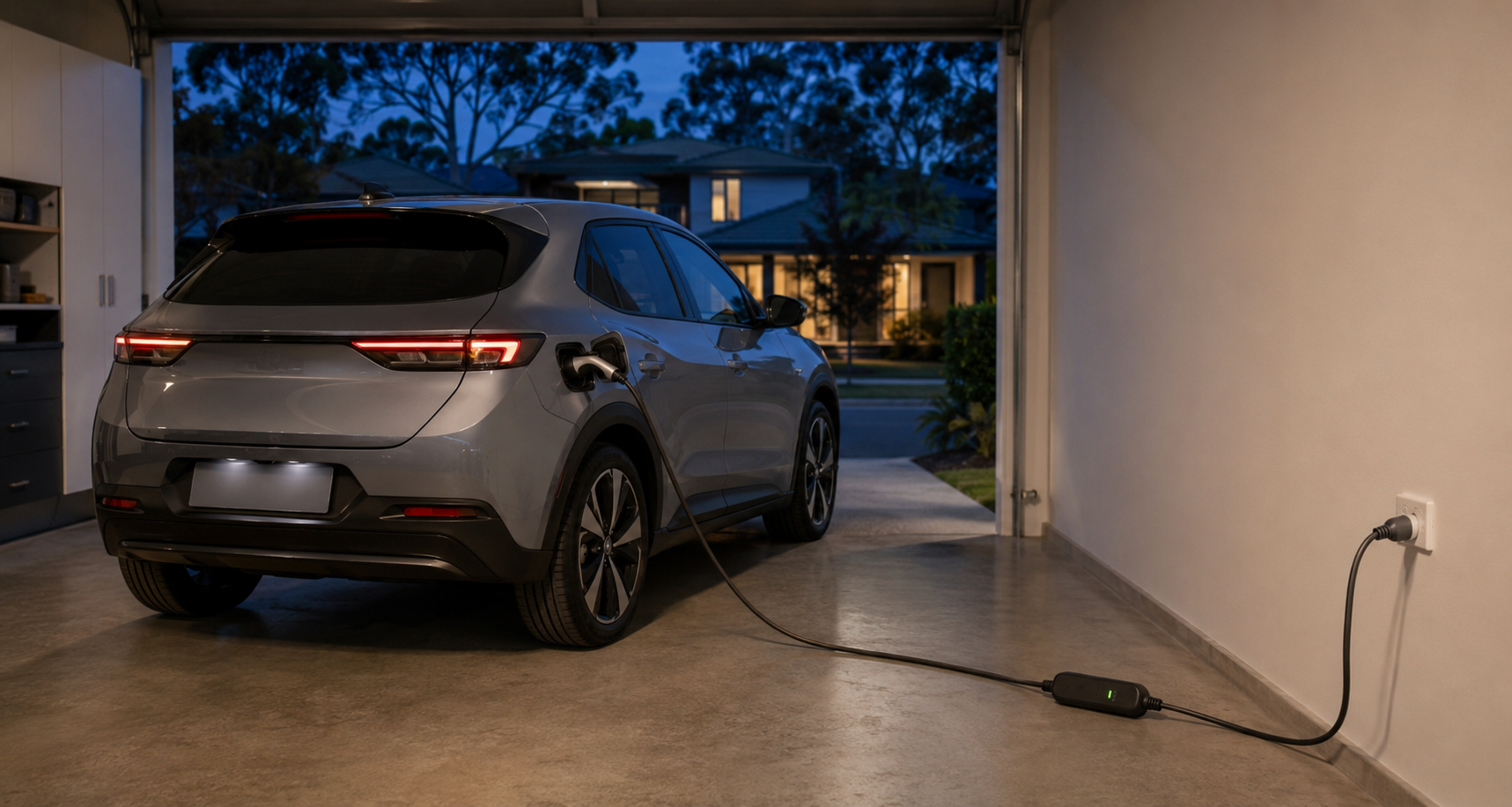
Most EVs come with a cable that plugs straight into a standard power point. So technically, yes, you can charge that way. The more useful question is whether you should, and the answer depends on your vehicle, your usage, and what your home's wiring can actually sustain overnight.
Can You Charge an EV from a Standard Power Point in Brisbane? (The Honest Answer)
The question gets asked constantly, and it deserves a straight answer rather than a sales pitch for an installation job. Yes, you can charge an EV from a power point in Brisbane using a standard Australian 10-amp outlet. Most EV manufacturers include a cable in the box specifically for this purpose. You plug one end into your car and the other into the wall, and charging begins. No electrician required, no new circuit, no additional equipment.
That is the complete answer to the question as asked. What follows is the more useful information about whether doing so makes practical sense for a Brisbane household, what the electrical implications are for sustained overnight charging on a standard outlet, and at what point a dedicated charging installation becomes the more rational choice.
Exclusive Electrical & Air works with Brisbane homeowners across suburbs including Kenmore, Hamilton, Toowong, Chermside, and The Gap. Rated 5 stars by Brisbane homeowners on Google, the team regularly fields questions about home EV charging from customers who have just taken delivery of a new vehicle and are working out their options. A common scenario worth flagging: a pre-1980s home in a suburb like Kedron with original wiring and power points that have never been formally assessed is not automatically a safe candidate for nightly sustained EV charging, even though nothing looks obviously wrong on the surface. That's the kind of thing a quick inspection settles before you commit to a nightly habit rather than after something starts feeling warm. 📞 0468 813 833.
What Standard Power Point Charging Actually Delivers
A standard Australian residential power point operates at 230 volts on a 10-amp circuit. The maximum continuous power delivery available from that outlet is 2.3 kilowatts. In EV charging terms, that translates to roughly 10 to 15 kilometres of range added per hour of charging, depending on the vehicle's onboard charging efficiency and battery chemistry.
To put that in practical terms, a popular mid-sized EV with a 75kWh battery pack, starting from 20 percent charge, needs somewhere in the vicinity of 28 to 32 hours of continuous standard power point charging to reach full capacity, once realistic charging losses are accounted for. From 50 percent, you are still looking at 16 to 18 hours to reach full.
For a Brisbane household where the vehicle covers 30 to 40 kilometres per day in typical suburban driving between Aspley, the CBD, and back, standard power point charging can arithmetically keep pace, provided the vehicle is plugged in every night and the battery never drops significantly. The maths works in that specific scenario. In most others, it gets uncomfortable quickly. A longer day, an unexpected detour, or a week of school runs and after-hours commitments can create a deficit that a standard outlet cannot recover overnight.
The Electrical Safety Consideration Most People Miss
Charging speed is the obvious practical limitation of a standard power point. The less obvious issue is what sustained maximum-draw operation does to a standard outlet and circuit over time.
A 10-amp power point is rated to handle 10 amps of continuous draw. An EV charging cable pulling that current continuously for eight to ten hours overnight is operating the outlet and its circuit wiring at sustained maximum capacity. This is a fundamentally different usage pattern from what a standard power point is designed for. Most household power points cycle through periods of load and rest. A kettle draws hard for two minutes. A phone charger draws a modest current for a few hours. An EV cable draws at or near the outlet's maximum rating for the entire overnight period.
The consequences of sustained maximum draw on an outlet or circuit that is not in perfect condition include heat generation at the connection points within the outlet, accelerated wear on the outlet's internal contacts, and in circuits with any existing wiring degradation or loose connections, a genuine overheating risk over time. This is not a theoretical concern. Many portable EV charging cables allow the current to be limited to a lower setting, such as 8 amps, specifically to build in a safety margin for outlets and wiring that may not be in ideal condition.
In Brisbane's older housing stock, particularly in established suburbs with properties built prior to the 1980s, wiring and outlet condition is not always consistent. A home in St Lucia, Mitchelton, or Kedron with original wiring and power points that have never been assessed is not necessarily a good candidate for sustained nightly EV charging on a standard outlet without an electrical inspection first. See our electrical safety inspection Brisbane service page.
Not sure whether your outlet and wiring can handle it? A quick assessment gives you a straight answer either way. 📞 0468 813 833 | Book Your outlet and wiring assessment.
When Standard Power Point Charging Is a Reasonable Option
There are genuine scenarios where standard power point charging is a workable choice, at least in the short term.
Drivers with low daily mileage who cover under 30 kilometres on most days and have a full overnight window available may find that a standard outlet keeps pace with their usage without creating a meaningful deficit. The vehicle does not need to reach 100 percent every night for the arrangement to be functional.
Standard charging also works well as a backup or occasional top-up option for households that have a dedicated wallbox as their primary charging method. Visiting family, charging at a second property, or managing an unexpected situation where the wallbox is unavailable are all scenarios where the supplied cable and a standard outlet fill the gap adequately.
Where it becomes problematic is as the sole and permanent charging solution for a household covering average or above-average daily distances, for larger-battery vehicles where the recovery time from a significant depletion is measured in days rather than hours, or for any household where the overnight charging window is compressed by early departures or late arrivals.
The Dedicated Circuit: What the Upgrade Actually Changes
A dedicated Level 2 wallbox installation on a 32-amp circuit changes the charging equation substantially. At 7.2 kilowatts for a standard single-phase installation, a wallbox delivers roughly three to four times the charge rate of a standard power point, adding 40 to 50 kilometres of range per hour. An overnight charging window of seven or eight hours is more than sufficient to recover a full day's usage for the vast majority of Brisbane driving patterns, regardless of vehicle battery size.
The circuit is designed and installed specifically for the sustained draw of EV charging. It is sized correctly, protected correctly, and built to operate at its rated capacity continuously without the thermal and wear implications of pushing a standard outlet to its limits night after night.
For Brisbane homeowners with solar panels, a smart wallbox can be configured to draw preferentially during solar generation hours, substantially reducing the grid electricity component of the charging cost. See our solar panel installation Brisbane service page.
The installation itself is notifiable electrical work under the Electrical Safety Regulation 2013 QLD, meaning it must be carried out by a licensed electrician and results in a Certificate of Testing and Compliance upon completion. If you're weighing up the switch to a dedicated wallbox, our EV charger installation guide covers the process, timeline, and what to expect on the day in more detail.
The Honest Verdict
Standard power point charging is a legitimate option in limited circumstances. It is not inherently dangerous on a well-maintained circuit in a home with sound wiring, and it serves a genuine purpose as an occasional or backup charging method. As a permanent primary solution for most Brisbane households, it falls short on both charging speed and the sustained electrical load it places on equipment not designed for that usage pattern.
If you are covering more than 30 kilometres a day, have a larger battery vehicle, or simply want overnight charging to be reliably complete without monitoring the maths, a dedicated wallbox installation is the more sensible long-term arrangement. The difference in day-to-day convenience is significant, and the electrical setup is straightforward when carried out by a licensed electrician following a switchboard assessment.
FAQ
Q: Is it legal to charge an EV from a standard power point in Queensland?
A: Yes. Using the manufacturer-supplied cable to charge from a standard 10-amp outlet requires no electrical work and involves no licensing requirements. Installing a dedicated wallbox or new circuit is a separate matter and does require a licensed electrician under the Electrical Safety Act 2002 QLD.
Q: Can I use an extension cord to charge my EV from a power point?
A: EV manufacturers and electrical safety authorities strongly advise against using extension cords for EV charging. Extension cords are not designed for sustained maximum-draw operation and introduce additional resistance and connection points that can overheat under EV charging loads. If the outlet is not conveniently located, a dedicated circuit routed to the appropriate location is the correct solution.
Q: How do I know if my power point and wiring can handle overnight EV charging?
A: A licensed electrician can assess the condition of the outlet, its circuit wiring, and the broader electrical installation to confirm whether sustained charging use is appropriate. This is particularly relevant for older Brisbane properties where wiring has not been recently assessed.
Q: Will charging from a standard power point damage my EV's battery?
A: Charging at Level 1 speeds does not damage the battery. The onboard charger in the vehicle manages the charge rate and battery protection regardless of the input source. The concern with standard power point charging is the impact on the outlet and circuit, not the vehicle's battery system.
Q: What happens if I trip the breaker while charging from a standard power point overnight?
A: The vehicle stops charging. Depending on when the trip occurs, you may wake up to a vehicle with less charge than expected. Repeated tripping from EV charging load is a signal that the circuit is not well suited to sustained charging use and should be assessed by a licensed electrician before continuing.
If you've had a trip like this and aren't sure why, it's worth getting checked before it happens again. 📞 0468 813 833.
If you are working out whether your home's wiring is suitable for standard power point charging, or whether a dedicated circuit makes more sense for your situation, Exclusive Electrical & Air can give you a straight answer based on your actual property rather than a generic recommendation.
The team carries out EV charger installations and electrical assessments across all Brisbane suburbs, including Kenmore, Hamilton, Toowong, Chermside, and Indooroopilly. All work is performed by licensed electricians, fully certified upon completion with a Certificate of Testing and Compliance, and backed by a workmanship warranty. Rated 5 stars on Google. 10+ years experience. 2,000+ Brisbane customers. Licensed Queensland Electrical Contractor.
Call 0468 813 833 or book online at https://www.exclusiveqld.com.au/connect to arrange an assessment for your property.