DC vs AC Ceiling Fans: Which Is Right for Brisbane Homes?
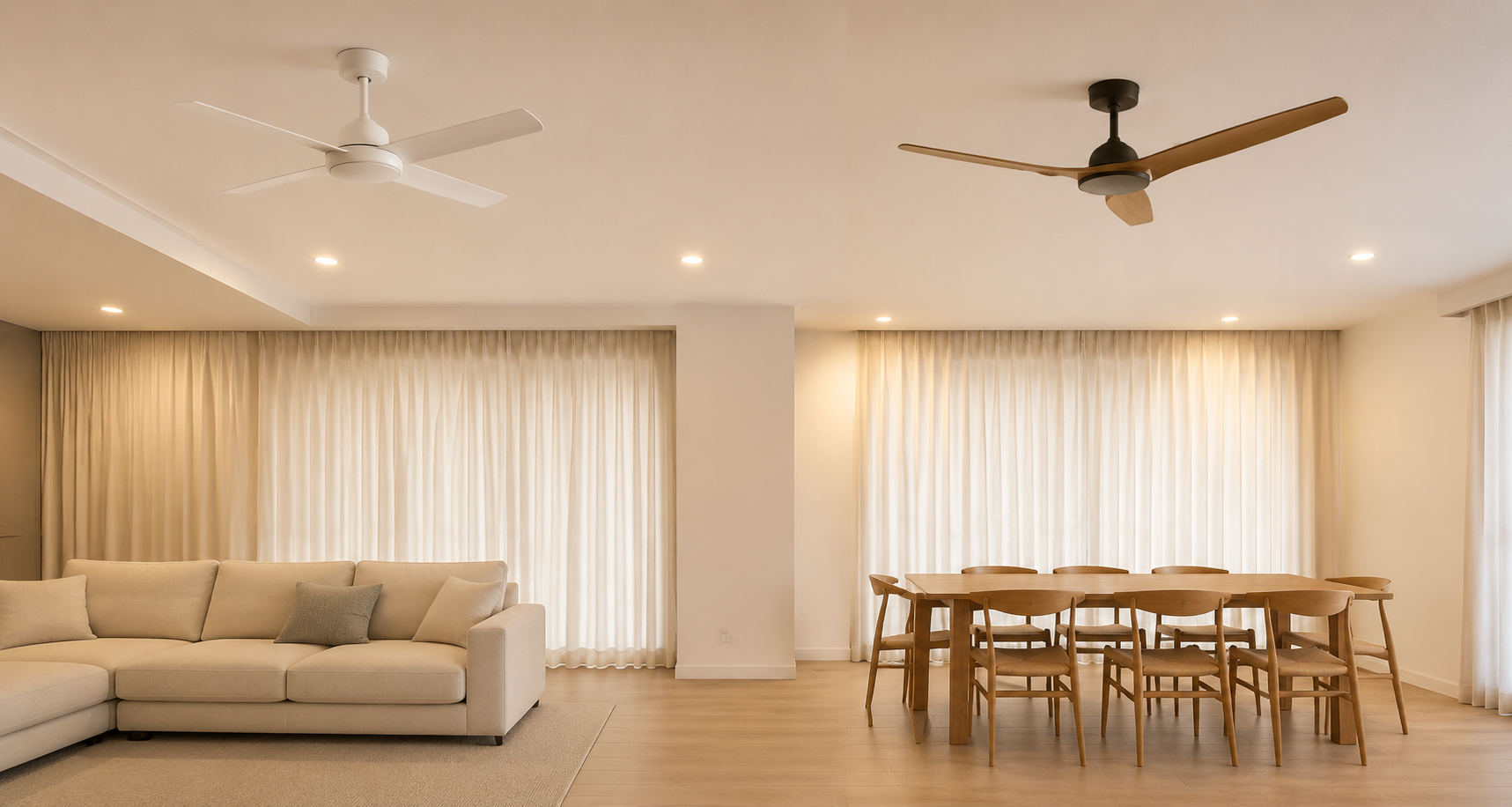
The choice between a DC and AC ceiling fan comes up the moment you start shopping, and the difference is not just marketing. Motor type affects energy consumption, noise level, speed control, and long-term running cost in ways that are directly relevant to how Brisbane households actually use their fans. Here is what each option genuinely offers.
DC vs AC Ceiling Fans: Which Is Right for Brisbane Homes?
Walk into any lighting or electrical retailer in Brisbane and you will find ceiling fans marketed around two motor types: DC and AC. The distinction is real and the difference in day-to-day performance between the two is significant, but it tends to get lost in a product description or glossed over by someone who just wants a fan that works and does not add too much to the power bill.
The motor type affects how much electricity the fan consumes, how quietly it runs, how many speed settings it offers, how it responds to controllers and smart home systems, and to a meaningful extent how long it lasts. For a Brisbane household where ceiling fans run for extended periods through the shoulder seasons and in combination with air conditioning through summer, those differences compound into a genuinely worthwhile decision rather than a trivial one.
A common version of this decision in practice: a household in a suburb like Toowong replacing four ageing AC fans across bedrooms and living areas with DC units. Individually the wattage difference on any one fan looks modest, but across four fans running most evenings through spring, summer, and autumn, the combined running cost gap over a Brisbane summer adds up to a noticeably lower number on the power bill than the same fans would have produced on AC motors.
Exclusive Electrical & Air installs ceiling fans across Brisbane for residential and commercial customers, with over a decade of experience and more than 2,000 customers served across suburbs including Kenmore, The Gap, Hamilton, Aspley, and Toowong. Rated 5 stars on Google. The team works with both DC and AC motor fans, and the following reflects what that installation and service experience tells us about how each performs in Brisbane's specific conditions. 📞 0468 813 833.
The Core Difference: What DC and AC Actually Mean
AC ceiling fans use an alternating current motor, the same type of motor that has powered ceiling fans since they were invented. The motor runs directly off the 230-volt alternating current supplied by your home's electrical system. AC motors are mechanically simple, robust, and well understood. They are also comparatively heavy, limited in the number of speed settings they can offer without additional control electronics, and less efficient at converting electrical energy into air movement than modern DC alternatives.
DC ceiling fans use a direct current motor, which requires the fan's internal electronics to convert the 230-volt AC supply from your wall into the direct current the motor runs on. That conversion step adds component complexity and cost, but the DC motor itself is significantly more efficient, lighter, quieter, and capable of a far wider range of operating speeds than an AC motor of comparable output.
The practical result of those differences is a fan category that costs more to purchase but less to run, performs more smoothly across its speed range, and integrates more readily with modern control systems including remote controls, smart home platforms, and variable speed wall controllers.
Energy Consumption: Where the Gap Is Most Relevant for Brisbane
Energy consumption is the difference most homeowners care about, and it is the one most directly relevant to a Brisbane household's decision.
A standard AC ceiling fan draws roughly 55 to 100 watts at typical operating speeds, depending on blade span, motor size, and speed setting. A quality DC ceiling fan of comparable size draws roughly 15 to 35 watts at similar air movement output. At the lower end of those ranges, a DC fan can use less than a third of the electricity of an equivalent AC model for the same air movement result.
For a household that runs ceiling fans for six to eight hours per day through Brisbane's extended shoulder seasons and overnight periods, that difference in consumption accumulates into a meaningful annual figure across multiple rooms. A home with four ceiling fans, each running an average of six hours daily for eight months of the year, saves considerably more in running costs with DC motors than AC across the life of the fans. The upfront price premium on DC fans, which typically sits somewhere in the range of $50 to $150 per unit depending on the model, is generally recovered within roughly two to three years of typical Brisbane usage. See the Queensland Government tips to reduce your electricity bill.
Noise: A Practical Consideration for Bedrooms and Open Plan Spaces
Operating noise is a difference that matters more to some households than others, but in Brisbane's context it is worth addressing directly.
AC motor fans produce a characteristic hum at operating speed caused by the electromagnetic properties of the alternating current motor. At higher speed settings, this hum becomes more pronounced. For bedrooms, open plan living areas, and home office spaces where background noise affects comfort or concentration, that hum is a relevant factor.
DC motor fans run significantly quieter across all speed settings. The direct current motor produces less electromagnetic noise, and the smoother speed regulation available through DC electronics means the fan operates more evenly at any given setting without the vibration variability that can make some AC fans noticeable in quieter rooms.
For Brisbane bedrooms where a fan runs overnight through the shoulder seasons as an alternative to air conditioning, the noise difference between a quality DC fan and a standard AC unit is one that many homeowners find directly affects sleep quality. It is not a minor consideration in that specific use case.
Speed Control and Compatibility
Speed settings are another point of meaningful difference. A standard AC ceiling fan typically offers three speed settings controlled via a pull chain, wall switch, or basic controller. Three speeds cover most use cases adequately but offer limited refinement for finding the specific air movement level that suits a room's occupancy and conditions.
A DC ceiling fan typically offers between six and twelve speed settings, with smoother transitions between them and a genuine low-speed option that moves air at a barely perceptible rate. That low-speed setting is particularly useful for overnight use in Brisbane's milder months, where minimal air movement is all that is needed for comfort during sleep.
Remote control is standard on most DC fan models and optional on many AC fans. For high-ceiling installations in Brisbane homes, particularly in open plan living areas or stairwells where a pull chain is impractical, remote control is a significant convenience factor.
Smart home integration is more readily available on DC fan platforms. DC fans with Wi-Fi or Zigbee connectivity can be controlled via smart home platforms, scheduled to run at specific speeds during solar generation hours, or integrated with temperature sensors for automated operation. For Brisbane households with smart home systems already in place, DC fan compatibility is worth checking during the selection process.
Where AC Fans Still Make Sense
The case for DC fans is strong for high-use applications, but AC ceiling fans are not without their place in a Brisbane home.
For lower-use rooms such as guest bedrooms, covered outdoor areas, or utility spaces where the fan runs infrequently and for short periods, the running cost difference between DC and AC motors is modest in absolute terms. In those situations, the lower upfront cost of an AC fan may be the more rational decision.
Outdoor and alfresco installations are an area where AC fans are common and appropriate. Many weatherproof ceiling fan models designed for outdoor use in Brisbane's humid conditions are built on AC motor platforms. While DC outdoor fans exist and are growing in availability, the AC option in outdoor-rated configurations is well established and represents reliable value for covered outdoor areas.
Budget-constrained projects where multiple fans are being installed simultaneously, and the upfront cost difference across several units is material, are another context where AC fans may be the practical choice. Not every room in every home requires the efficiency premium of a DC motor.
Not sure which motor type makes sense room by room? An assessment can walk through your specific rooms and usage rather than a one-size-fits-all answer. 📞 0468 813 833 | Book Your ceiling fan assessment.
Installation: What Both Types Require in Queensland
Regardless of motor type, ceiling fan installation that involves any electrical wiring connection is notifiable electrical work under the Electrical Safety Regulation 2013 QLD and must be carried out by a licensed electrician. This covers the vast majority of new ceiling fan installations in existing Brisbane homes, where connection to a lighting circuit or new ceiling outlet is required.
DC fans have an additional installation consideration. The internal electronics that convert AC supply to DC add a small amount of complexity to the wiring configuration compared to a direct AC connection, and the wall controller or remote receiver must be correctly matched to the specific fan model. An experienced electrician confirms compatibility and configures the control system as part of the installation.
Both motor types require appropriate ceiling mounting assessment to confirm the ceiling structure can support the fan's weight, with DC fans typically lighter than equivalent AC models due to the smaller motor size. See our electrical installations Brisbane service page. The installation is completed with a Certificate of Testing and Compliance where the work meets the notifiable threshold under the Electrical Safety Act 2002 QLD.
FAQ
Q: Are DC ceiling fans worth the extra cost for a Brisbane home?
A: For high-use rooms such as living areas, master bedrooms, and any space where the fan runs for extended daily periods, the energy saving of a DC motor typically recovers the price premium within two to three years of Brisbane usage patterns. For low-use rooms, the calculation is less clear-cut and an AC fan may represent better overall value.
Q: Can I replace an existing AC ceiling fan with a DC model on the same wiring?
A: In most cases yes, though the wall controller must be compatible with the DC fan's electronics. A standard AC fan speed controller is not compatible with most DC motor fans and must be replaced with the correct controller for the specific model. A licensed electrician confirms compatibility and completes the changeover correctly.
Q: Do DC ceiling fans work with smart home systems?
A: Many DC fan models include Wi-Fi or RF remote control systems that are compatible with smart home platforms. Compatibility varies by brand and model, so confirming integration capability with your specific platform before purchase is recommended. Your electrician can advise on models that suit your existing setup.
Q: What blade span do I need for my Brisbane living area?
A: As a general guide, rooms up to 15 square metres suit a 900 to 1,200 millimetre blade span. Larger rooms benefit from a 1,200 to 1,500 millimetre span or multiple fans positioned to cover the full floor area. A licensed electrician can advise on appropriate sizing and positioning during a site visit.
Q: Can I install a DC ceiling fan in an outdoor alfresco area?
A: Yes, provided the fan selected carries an appropriate IP weather rating for the exposure level of the installation location. Both DC and AC fans are available in weatherproof outdoor-rated configurations. A licensed electrician confirms the appropriate specification for the specific installation location during the site assessment.
Still deciding between motor types for a specific room? Happy to talk it through before you buy anything. 📞 0468 813 833 | Book Your ceiling fan assessment.
Whether you are replacing an existing fan, fitting out a new room, or working out the right combination of fans and air conditioning for your Brisbane home, the motor type decision is worth making deliberately rather than defaulting to whichever box is cheapest on the shelf.
Exclusive Electrical & Air installs DC and AC ceiling fans across all Brisbane suburbs, including Kenmore, Toowong, Hamilton, Chermside, and Indooroopilly. All installations are carried out by licensed electricians, fully certified upon completion, and backed by a workmanship warranty. Rated 5 stars on Google. 10+ years experience. 2,000+ Brisbane customers. Licensed Queensland Electrical Contractor.
Call 0468 813 833 or book online at https://www.exclusiveqld.com.au/connect to arrange a ceiling fan installation or assessment for your Brisbane property.