Outdoor Power Points Not Working After Summer | Brisbane
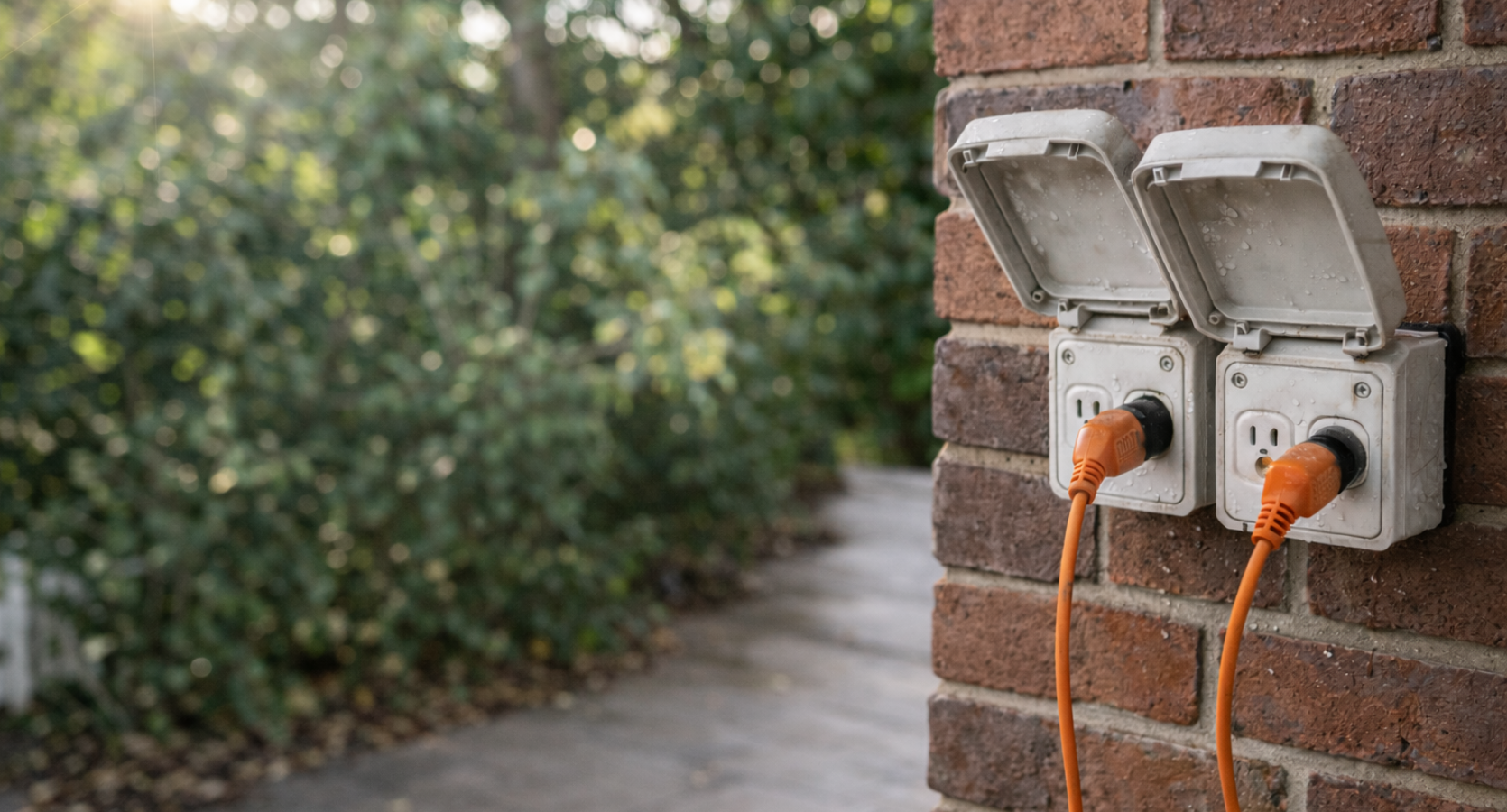
If your outdoor power points stopped working after summer, that’s not normal. Brisbane heat, humidity and storms expose hidden faults. Here’s what’s really going on and when to call a licensed electrician.
If your outdoor power points stop working after summer, that’s not normal.
Brisbane’s heat, humidity and storms are tough on gear outside, but a healthy power point (GPO) should still work. When it doesn’t, you’ve likely got moisture in the fitting, UV damage, a loose connection, or a device fault that’s tripping protection. That’s the switchboard doing its job, but it’s also a warning.
After storm season we see this across all Brisbane suburbs. Bayside homes cop salty air. Queenslanders have points out on decks and under eaves. Heatwaves cook seals and plastics. Voltage dips during peak demand stress weak connections. The fault usually shows up at the first big wet or the first hot day after.
Here’s the truth:
Most outdoor power failures aren’t random. They’re predictable results of water, heat, and weak connections.
When a safety switch (RCBO) trips, it’s usually protecting you from real leakage to earth.
Let’s look at the most common reasons Brisbane outdoor power points stop after summer.
1. Water ingress inside the power point
Even “weatherproof” points age. Gaskets flatten. Lids don’t seal. Wind-driven rain and humid nights let moisture creep into the body. In Brisbane, moisture can also condense inside the enclosure after hot days.
Water tracks across insulation to earth. That leakage will trip your safety switch, or corrode contacts so nothing energises. Left alone, the contact resistance climbs and heat damage follows.
At this point, you may see:
✔ Safety switch tripping the moment you plug in a tool
✔ Condensation under the clear cover or foggy lens
✔ Green or white buildup on screws or terminals
✔ A dull, gritty feel when flipping the cover or switch
✔ The point works in dry weather, fails after rain
2. UV-cracked covers and perished seals
Brisbane sun is brutal. UV embrittles plastic and perishes the rubber seals that keep water out. After a long summer, the lid may look fine but the seal gap is enough for capillary water entry.
Once UV breaks the seal, spray from hoses, storms, or even sideways rain gets in. That sets up corrosion and leakage paths that only show up when you need power.
At this point, you may see:
✔ Yellowing, crazing, or hairline cracks in the cover
✔ A lid that no longer snaps firmly shut
✔ Sand or dust crusted into the seal groove
✔ Rust stains at screw heads or hinge points
✔ The point fails only after washing the patio or boat
3. Heat expansion loosening terminals
Repeated heat cycles through summer loosen screws and spring contacts. Metals expand and contract. If the original termination wasn’t perfect, the conductor relaxes and the connection turns high-resistance.
A loose active or neutral can kill the point under load, create arcing, or trip protection. It can also overheat the faceplate, leaving you with a dead or intermittent outlet.
At this point, you may see:
✔ Intermittent power when you wiggle a plug
✔ A faint hot or plasticky smell at the fitting
✔ Slight browning around the switch rocker
✔ The point runs a pressure washer briefly then dies
✔ Other points on the same circuit stay fine
4. Waterlogged conduits and outdoor junction boxes
Summer storms push water into conduits that feed garden points. Low points fill and don’t drain. Older Queenslanders and patios often have junction boxes tucked under decks where spray and humidity are constant.
When water sits around conductors, tiny faults to earth appear. It might not trip all the time, only when the soil is wet or the load is heavy. Eventually, corrosion takes over and the point stops.
At this point, you may see:
✔ Safety switch trips only after heavy rain
✔ Ant nests or mud in the conduit mouth
✔ Drips from a junction box when disturbed
✔ Gurgling or moisture sounds when moving the cover
✔ Nearby garden lights also playing up
5. Corrosion from salty air in bayside suburbs
Bayside breezes carry salt. Salt speeds up corrosion on terminals, switches, and the spring contacts inside the socket. Once corrosion raises resistance, voltage at the point sags and loads stall or trip protection.
You might not notice until the first big job after summer. Pressure cleaner, pool pump service, or an outdoor fridge start. Then the weak point shows up fast.
At this point, you may see:
✔ Green copper salts on earth or neutral screws
✔ Plug pins discolouring or pitting early
✔ Arc marks on the socket contacts
✔ A tool starts slow, then the point dies
✔ The same tool works fine on an indoor point
6. Insects and geckos inside the enclosure
Ants love warm, sheltered fittings. Geckos slip past tired seals. Bodies, droppings, and debris create conductive tracks. That’s all it takes to trip a safety switch or foul a switch mechanism.
Post-summer hatchings are common around gardens and pool areas. Once they’re in, the fault can be intermittent until the contamination builds.
At this point, you may see:
✔ Fine grit or insect bodies under the lid
✔ A sticky or notchy switch action
✔ Safety switch trips randomly with light loads
✔ Tiny scorch marks where tracking has occurred
✔ Gecko droppings inside the clear cover
7. Fault in the appliance you’ve plugged in
Sometimes the point is fine. The load isn’t. Pool pumps, pressure cleaners, outdoor fridges, and Christmas lights can develop insulation faults over summer. When you plug in, the safety switch sees leakage and trips.
This is common after storms or storage in humid sheds. The point then appears “dead” because the safety switch is out and the circuit is off.
At this point, you may see:
✔ Safety switch won’t reset until the appliance is unplugged
✔ The same appliance trips other outdoor points
✔ No scorch or damage at the power point itself
✔ The circuit breaker is on, but the safety switch is off
✔ The fault shows up as soon as the appliance starts
Is This Normal?
Not really. Outdoor points don’t just “get tired” after summer.
Brisbane conditions expose weak links, but the underlying issue is a fault.
Moisture, UV, and loose connections are preventable with the right gear and installation.
A tripping safety switch is doing its job. It’s also telling you something’s leaking to earth.
Voltage dips during peak demand can reveal a marginal connection. They don’t cause a healthy power point to fail.
If a point only works in dry weather, that’s moisture or tracking, not bad luck.
If it smells hot or looks browned, that’s active heat damage. That’s not normal at all.
When You Should Call an Electrician
Call when the power point won’t reset or keeps tripping the safety switch.
Call if you see browning, melting, or you can smell hot plastic.
Call if rain or hose use reliably kills the point. That’s water entry.
Call for any outdoor point on older Queenslanders or bayside homes that’s gone intermittent.
If you’re unsure whether it’s the point or the appliance, we’ll test both safely.
Safety switch keeps tripping and won’t hold
The point is dead while the breaker looks on
Visible corrosion, cracks, or loose cover
Power returns only after long dry spells
You’ve had storm flooding around conduits
As a safety measure only, if you smell burning or see water inside, turn off the affected circuit at the switchboard. Then leave it off and call us. Don’t open fittings or try to dry them with heaters. That can make tracking worse.
Outdoor power points in Brisbane work hard. Sun, storms, humidity and salt push them to the edge.
When they stop after summer, it’s nearly always moisture, UV damage, a loose or corroded connection, or a faulty appliance tripping protection. None of that is “normal wear.” It’s a fixable fault. The good news is we can isolate the exact cause, replace compromised fittings with the right weather rating, tidy terminations, and separate problem loads so your safety switch stays quiet.
That’s safer for your family and better for your gear. If you’ve got an outdoor point that’s become unreliable, let’s get it sorted properly.
👉 Need a licensed Brisbane electrician to diagnose an outdoor power point? Exclusive Electrical & Air will test the circuit, the safety switch, and the point itself, then repair the actual fault.
👉 We service all Brisbane suburbs, from inner-city Queenslanders to bayside homes. Book a professional assessment and get your outdoor power reliable again.
👉 Call Exclusive Electrical & Air today and we’ll take it from here.