Power Goes Off When the Microwave Turns On (Circuit Overload or Wiring Fault?)
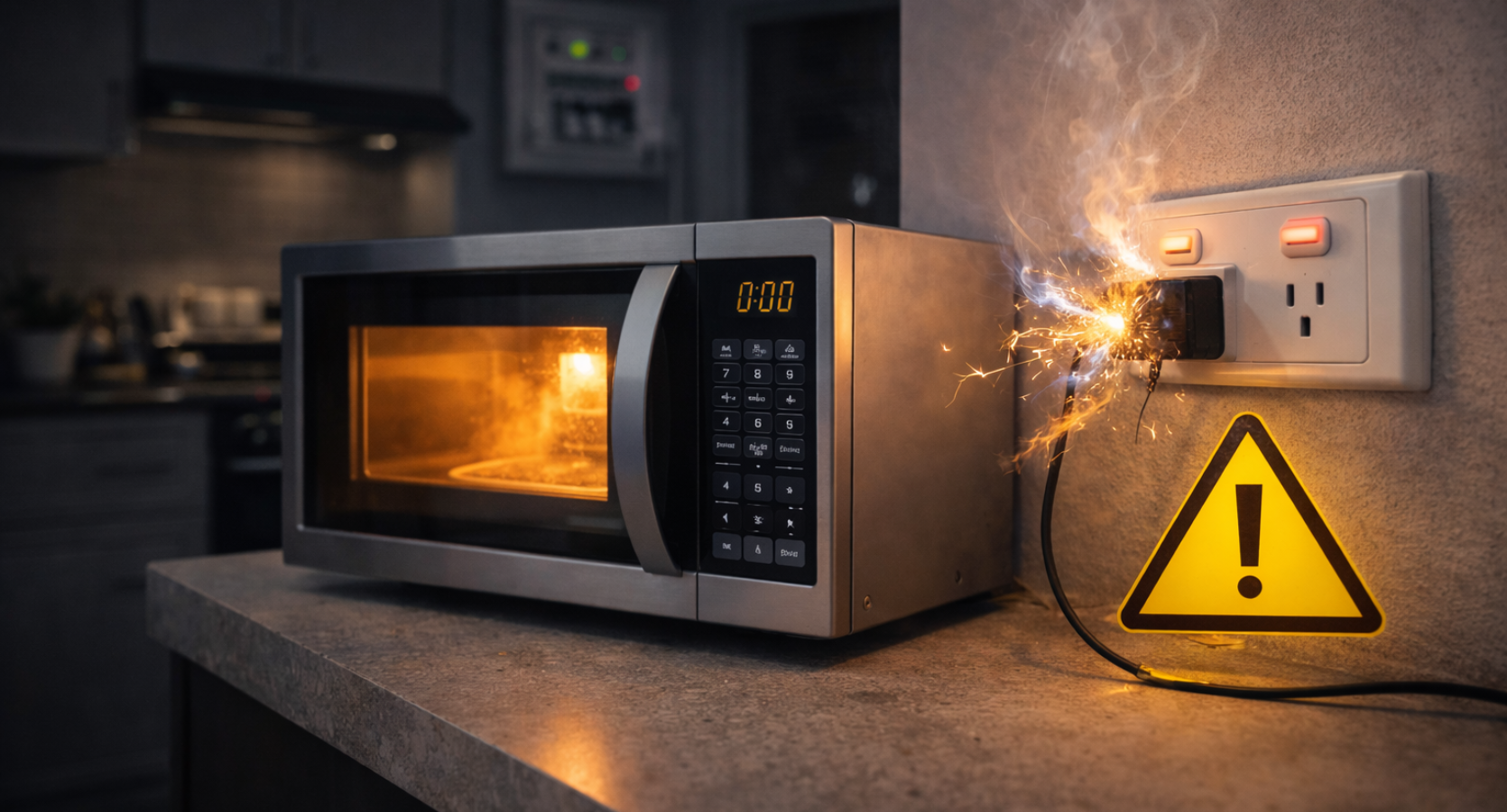
If your power cuts the moment the microwave starts, that’s not normal. In Brisbane, it’s usually overload, earth leakage, or a weak connection. Here’s what’s really going on and when to call an electrician.
If the power drops as soon as your microwave starts, that’s not normal.
Something on that circuit can’t cope with the load, or there’s leakage to earth that your safety switch (RCBO) is catching.
Good news: the protection is doing its job. But the cause needs attention. In Brisbane, humidity, storm season, voltage dips during heatwaves, and older Queenslander wiring make this show up more.
Quick Diagnosis Checklist
Did the safety switch trip or just a circuit breaker?
Did all power points go off, or just kitchen?
Was the kettle, toaster, or airfryer also on?
Is the microwave on a power board or extension lead?
Any recent storms, leaks, or roof work?
Do you smell warm plastic at the power point?
Does it only happen at dinner peak times?
Does the fridge restart when it trips?
Causes:
1) Overloaded kitchen power circuit
Your microwave is a heavy load. If it shares the same circuit as the kettle, toaster, airfryer, or fridge, the combined draw can exceed the circuit rating. The circuit breaker opens to protect the wiring. It’s common in homes where the kitchen and other rooms share one general power circuit.
Why it happens in Brisbane: Peak demand hits at dinner in heatwaves. Aircons run, fridges cycle hard, and voltage can dip under load. In older Queenslanders, long cable runs and shared circuits don’t help. Add a high-draw microwave and the margin disappears. The breaker trips before the cable overheats.
Signs:
Breaker trips, not safety switch
Happens with kettle or toaster on
Fridge clock resets
Only some power points dead
No burning smell
Works fine when other loads off
Why it matters:
Repeated trips stress breakers
Hidden hot joints risk damage
Food safety if fridge drops
Indicates undersized or shared circuit
2) Faulty microwave leaking to earth
What it is: A fault inside the microwave allows a small current to leak to earth. Common culprits are the filter, capacitor, or moisture inside the cabinet. Your safety switch detects this and trips fast. You reset, start again, and it trips immediately when the motor or magnetron kicks.
Why it happens in Brisbane: Humidity creeps into appliances. Bayside salty air accelerates corrosion. After storm season, moisture sits where it shouldn’t. Even a healthy unit can leak a little; a fault lifts it over the limit, especially right at startup when components stress.
Signs:
Safety switch trips instantly
Trips even when nothing else on
Microwave buzzed or smelt odd
Cabinet feels damp or clammy
Happens on any power point
Other appliances run fine
Why it matters:
Shock protection event
Risk of internal arcing
Damage worsens with use
Appliance may be unsafe
3) Cumulative leakage on the circuit
Many modern appliances leak tiny currents through filters. One by itself is fine. Stack a few on the same circuit, then the microwave starts, and the total leakage crosses the safety switch threshold. The trip feels random, but it’s the sum of little leaks plus the microwave surge.
Humid nights, wet walls, and under-house moisture in Queenslanders increase surface leakage. After storms, damp power points and junction boxes add more. Combine that with dinner-time load and voltage dips and the safety switch becomes sensitive to the slightest push.
Signs:
Safety switch trips, not breaker
Different appliances trigger at times
Worse in humid weather
Dryer or dishwasher on same circuit
No single appliance always guilty
Trip delay a second or two
Why it matters:
Masks a hidden moisture issue
Interrupts kitchen and fridge power
Could indicate damp wiring
Calls for circuit-by-circuit testing
4) Loose or burnt power point (GPO) or plug
Worn contacts in the power point, heat-damaged terminals, or a loose plug create resistance. When the microwave draws hard, the bad joint heats, arcs, and can trip protection. You might notice the plug doesn’t feel snug, or the faceplate looks discoloured.
Heatwaves push loads up. Humidity and salty air near the bayside accelerate corrosion on contacts. In older Queenslanders, some power points live in hot, uninsulated walls. Repeated high current cycling from kitchen appliances then cooks weak joints.
Signs:
Warm or brown power point
Crackling or sizzling sounds
Plug wobbles in socket
Plastic smell near the point
Marking around the pins
Trips after a few seconds
Why it matters:
Fire risk from arcing
Damage spreads to cabling
Trips will get more frequent
Needs prompt replacement
5) Loose neutral or weak joint in the circuit
A poor neutral or phase connection in a junction box, under the floor, in the roof, or at the switchboard. Under microwave load, the joint heats or arcs. That causes voltage instability and can trip the breaker or safety switch, depending on how the fault presents.
Queenslanders often have under-house joins, older bakelite boxes, and long runs. Storm-season leaks or pests disturb joints. Heat expands metals; cool nights contract them. Over time, screws loosen. When the microwave hits, the shaky joint shows itself.
Signs:
Lights dip when microwave starts
Random tripping across circuits
Occasional buzzing at switchboard
Hot smell near cupboard or wall
Intermittent, weather-sensitive fault
Burn marks in old junction boxes
Why it matters:
Potential for arcing fire
Equipment damage from drops
Nuisance outages grow worse
Needs test and re-terminate
6) Water ingress in a power point or junction box
Moisture inside an outlet, splash-back power point, under-bench socket, or an outdoor/under-house join. When the microwave draws current, the leakage to earth spikes. The safety switch trips to protect you. Sometimes it only appears after rain or when the dishwasher runs.
Storm season wind-drives rain into eaves and vents. Humid kitchens sweat. Under-floor air in Queenslanders stays damp. Bayside salt draws moisture. Even a hairline crack in a faceplate can let water track onto energised parts.
Signs:
Safety switch trips post-rain
Damp or stained wall plate
Condensation under benchtop
Corrosion on screws or pins
Trips with dishwasher or sink use
Musty smell near the point
Why it matters:
Shock and fire hazard
Corrosion accelerates failure
Hidden leaks worsen quickly
Needs dry-out and replacement
7) Aging or mismatched protection in the switchboard
Old breakers become weak. Some homes have shared safety switches feeding many circuits. Inrush from a microwave can over-sensitise tired devices, or the wrong breaker curve might nuisance-trip. Loose terminations at the neutral bar add to the instability.
Older switchboards are common across inner suburbs and Queenslanders. Summer heat and roof-space temperatures bake gear. Storms and surges don’t help. Add peak-time voltage dips and the margin is gone. The weakest link trips first.
Signs:
Frequent trips across days
Warm breaker or safety switch
Brittle or yellowed gear
Labels missing or wrong
Rattly cover or humming
Trip with moderate loads
Why it matters:
Reduced protection reliability
Masking real circuit faults
Higher fire and shock risk
Needs proper device selection
What NOT to do
Don’t keep resetting repeatedly
Don’t move the microwave to a dodgy power board
Don’t tape or hold a breaker on
Don’t bypass or replace a safety switch yourself
Don’t ignore heat, smell, or buzzing
Don’t use the microwave if the casing is damp
Don’t run long extension leads for heavy loads
Don’t open the microwave cabinet
When it’s a safety emergency
Burning or melting plastic smell
Scorch marks on the power point
Crackling, buzzing, or sizzling sounds
Smoke, steam, or visible arcing
Safety switch trips instantly and repeatedly
Microwave cabinet wet or water on bench
Storm water ingress around kitchen or switchboard
Power point is hot to touch
Tingles or shocks from the microwave
Main switch or breaker feels hot
Lights browning out across rooms
Any sign of water near live parts
A microwave tripping the power isn’t “just one of those things.” It’s your home telling you the circuit, the appliance, or the protection isn’t right. In Brisbane, heat, humidity, and storm season push weak spots over the edge. The fix starts with proper testing: identify whether it’s overload, earth leakage, or a loose connection, then correct the exact fault. That protects your family, your food, and your wiring. If it keeps happening, don’t power through it. Get it checked.
If your microwave keeps taking out the power, book a licensed local who diagnoses first, not guesses. Exclusive Electrical & Air tests the circuit, the power point, and the appliance under real load, then fixes the root cause. We work across all Brisbane suburbs, from Queenslanders to new builds, in all seasons. Call or book online and we’ll get your kitchen steady and safe again.