Why Your Brisbane Home's Power Points Keep Tripping the Breaker
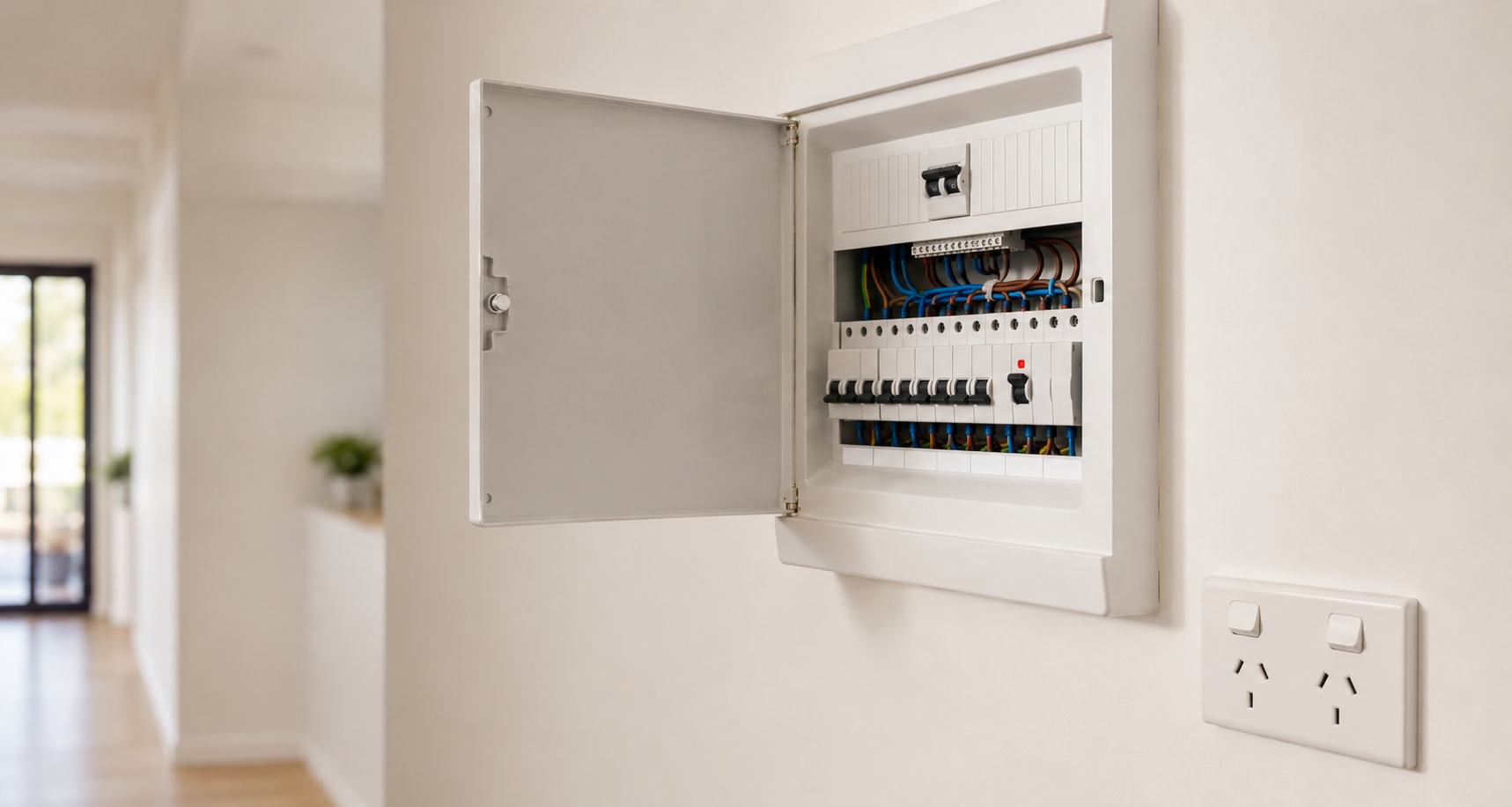
If your power points keep tripping the breaker or safety switch, resetting and hoping for the best is not a strategy. Repeated tripping is a symptom of a specific electrical fault, and in Brisbane's older housing stock, several causes are more common than most homeowners realise.
Why Your Brisbane Home's Power Points Keep Tripping the Breaker
Every Brisbane homeowner knows the routine. Something trips in the switchboard, the power in part of the house goes out, and you head to the meter box to reset whichever breaker or safety switch has flicked off. It comes back on. Life continues. The same thing happens again three days later. If you're dealing with power points tripping the breaker repeatedly in your Brisbane home, that pattern is telling you something specific.
Repeated tripping is not a quirk of your switchboard. It is a symptom. Something on that circuit is drawing more current than it should, creating a fault current that the protection device is correctly detecting, or deteriorating to the point where normal operation is no longer possible. The breaker or safety switch is doing exactly what it was installed to do. The problem is whatever is causing it to activate repeatedly.
Exclusive Electrical & Air has been diagnosing and resolving electrical faults across Brisbane for over a decade, with more than 2,000 residential and commercial customers served across suburbs including Chermside, Mitchelton, Toowong, Kenmore, and Hamilton. Rated 5 stars by Brisbane homeowners on Google, the team has seen the full range of causes behind recurring breaker trips. A common pattern: a safety switch that gets reset repeatedly over a couple of weeks, holding for a day or two each time before tripping again, ends up traced not to the wiring or the power point but to a single appliance, often an air conditioner with deteriorated motor winding insulation, leaking just enough current under load to trip the switch. Once that's identified, the fix is straightforward, and the diagnosis itself often takes less time than the homeowner expects.
This guide explains the most common reasons Brisbane power points trip breakers and safety switches, how to tell which type of fault you are dealing with, and when the situation requires a licensed electrician rather than another reset.
Why Do Brisbane Power Points Trip the Breaker or Safety Switch?
Power points trip breakers due to overloaded circuits, short circuits, ground faults, faulty outlets, failing appliances, or deteriorated wiring. In Brisbane homes with older electrical installations, undersized circuits are a frequent cause. A safety switch trip and a breaker trip indicate different fault types and require different investigation approaches.
Circuit Breaker vs Safety Switch: Which Is Tripping Your Brisbane Home?
Before looking at causes, it is worth being clear on what is actually tripping, because the two devices protect against different things and their activation points to different fault types.
A circuit breaker protects against overloads and short circuits. It monitors the current flowing through a circuit and trips when that current exceeds the breaker's rated capacity, or surges suddenly as it does in a short circuit. A tripped breaker will typically be in a middle or off position, separate from the other breakers in the switchboard.
A safety switch, technically called a residual current device (RCD), protects against earth leakage faults. It compares the current flowing out on the active wire against the current returning on the neutral wire. If those figures do not match, current is flowing somewhere it should not, possibly through a person, through a faulty appliance casing, or through degraded wiring insulation contacting an earthed surface. The safety switch detects that imbalance and trips within milliseconds.
Queensland regulations require safety switches on power and lighting circuits in residential properties, as set out under the Electrical Safety Regulation 2013 QLD. If your home has safety switches installed, their repeated operation is not a fault in itself. It means the device is detecting a leakage fault somewhere on the circuit and responding correctly.
Not all trips indicate a serious fault. A safety switch can trip from a brief current surge when a motor starts, from moisture in an outdoor fitting after rain, or from a minor transient fault that resolves itself. A single trip that holds on reset and does not recur may be a nuisance trip rather than an ongoing fault. It is repeated tripping, or tripping that occurs immediately upon reset, that warrants prompt investigation.
Knowing which device is tripping when you plug something into a power point narrows the cause considerably before a licensed electrician even arrives.
Six Reasons Brisbane Power Points Keep Tripping the Breaker
Overloaded circuits are the single most frequent cause of breaker trips in Brisbane homes. Every circuit has a rated current capacity, typically 20 amps for power circuits in residential properties, which works out to around 4,600 watts of combined load. A 2.5kW reverse-cycle split system can draw somewhere in the order of 10 to 12 amps at startup. Add a kettle or another high-draw kitchen appliance on the same circuit and you can be right at or over the breaker's rated capacity. This happens most commonly in homes, old and new alike, where multiple high-draw appliances share a circuit that was not designed for that cumulative load. In Brisbane, the problem is particularly acute over summer when multiple air conditioning units run simultaneously. A home in Aspley, The Gap, or a newer estate running two split systems on the same circuit that also serves the kitchen may push that circuit to its limit on a thirty-five degree day in a way that never occurs in winter.
Short circuits occur when a live wire makes direct contact with a neutral wire, causing a sudden and massive surge in current that trips the breaker immediately. Short circuits are caused by damaged wiring inside walls or ceilings, deteriorated appliance cords with exposed conductors, or faulty power point internals where contacts have worn or broken. A short circuit trip is usually immediate upon connecting something to the power point and typically trips the breaker rather than the safety switch.
Ground faults occur when current finds a path to earth that it should not be taking. This includes current leaking through deteriorated wiring insulation, through a wet or conductive surface, or through the casing of an appliance with a faulty internal connection. Ground faults are exactly what safety switches are designed to detect and interrupt. If your safety switch trips rather than your circuit breaker, a ground fault is the most likely cause.
Faulty power points are a cause that often goes overlooked because homeowners tend to assume the wiring or the appliance is at fault rather than the outlet itself. A power point with loose internal connections, corroded or damaged contacts, or degraded wiring at the terminal block can create arcing or resistance faults that trigger the protection device. Power points that feel warm when no high-draw appliance is connected, show discolouration or scorch marks around the faceplate, or spark intermittently when a plug is inserted are displaying symptoms of an internal fault and should be assessed promptly. A simple test: move the appliance that causes the trip to a power point on a different circuit and see whether the problem follows the appliance or stays with the outlet. If the safety switch holds on the new circuit, the outlet is the more likely fault. If it trips again regardless of which outlet is used, the appliance is the more likely cause.
Faulty appliances account for a significant proportion of safety switch trips. An appliance with deteriorated cord insulation, a failing motor, or a damaged heating element can leak current to its casing at the moment of connection, triggering the safety switch. The diagnostic approach here is straightforward: unplug appliances from the circuit one at a time and identify whether the safety switch holds when a specific device is removed. If it does, that appliance is likely the source. It should not be used again until assessed or replaced.
Ageing or undersized wiring is the cause that concerns licensed electricians most in Brisbane's older housing stock. Homes built before the 1980s in suburbs like Mitchelton, Kedron, St Lucia, Paddington, Ashgrove, and parts of Indooroopilly frequently retain original wiring sized for the electrical loads of a different era. Wiring in service for forty or fifty years may have degraded insulation, corroded connections, or conductors simply undersized for the demands a modern household places on them. This type of fault does not always trip the breaker cleanly. It may cause intermittent trips, overheating at connection points, or a gradual increase in nuisance trips over time. Insulation resistance testing is one of the key diagnostic tools here, applying a DC voltage to the wiring insulation and measuring how well it resists current flow. A result below the minimum threshold under AS/NZS 3000 indicates wiring that has degraded and is at risk of causing ground fault trips or more serious faults under load. If your switchboard still contains ceramic fuses rather than modern circuit breakers and safety switches, repeated power point trips are a sign the board itself needs assessment, since ceramic fuses provide no earth leakage protection and do not trip cleanly under fault conditions modern devices are calibrated to intercept.
If your home has not had its wiring assessed and you are dealing with recurring trips across multiple circuits, a residential electrical safety inspection Brisbane is the appropriate starting point.
Identified your fault type from the list above? A licensed electrician can diagnose the specific cause and have it resolved in a single visit across most Brisbane suburbs. 📞 0468 813 833 | Book Your fault investigation.
What Brisbane Homeowners Can and Cannot Do When a Breaker Keeps Tripping
What you can do:
✔ Reset a tripped breaker or safety switch once to see whether it holds
✔ Unplug appliances from the affected circuit one at a time to identify whether a specific device is responsible
What you cannot do:
✔ Open the switchboard to inspect or modify wiring
✔ Replace a power point yourself
✔ Bypass or manually hold on a safety switch that is tripping repeatedly
All of this is regulated electrical work under the Electrical Safety Act 2002 QLD and must be carried out by a licensed electrician. A safety switch that is held on manually or disabled is not protecting anyone. The fault it was detecting is still present.
If a breaker trips and you notice burning smells, scorch marks around a power point, or the breaker is warm to touch when you reach the switchboard, do not reset it. Turn off the main switch if safe to do so and contact a licensed electrician immediately. These are signs of a fault that has generated heat, which represents a fire risk.
If your switchboard is repeatedly tripping and the cause is not immediately obvious, the right call is a licensed electrician. Before engaging anyone for fault investigation, verify their Queensland electrical contractor licence through the QBCC licence register at qbcc.qld.gov.au. Exclusive Electrical & Air carries out electrical fault finding and circuit assessments across Brisbane, including same-day attendance where the situation requires it. Call 0468 813 833 to arrange a time.
What a Licensed Brisbane Electrician Checks When Diagnosing Repeated Trips
When an Exclusive Electrical & Air electrician attends to investigate repeated breaker or safety switch trips, the assessment covers circuit load relative to rated capacity, condition of the power point or points involved, insulation resistance testing of accessible wiring, switchboard condition including breaker and safety switch function, and identification of any appliances contributing to the fault.
From that assessment, the cause is identified and the appropriate repair is carried out, whether that is a power point replacement, a circuit upgrade, a wiring repair, or a switchboard modification to better distribute load across circuits. See our switchboard upgrades Brisbane service page.
Electrical fault finding in Brisbane typically falls under an hourly labour rate in the vicinity of $110 to $180 plus a call-out fee, with most straightforward fault diagnoses resolved within one to two hours. Where the fault requires a power point replacement, circuit upgrade, or wiring repair, a separate quote covers that scope before work proceeds. Where notifiable electrical work such as a circuit upgrade, power point replacement, or wiring repair is carried out, the completed work is covered by a Certificate of Testing and Compliance confirming it meets Queensland's electrical safety standards. While on site for a fault investigation, we can also check your smoke alarm compliance ahead of Queensland's 1 January 2027 deadline, one visit, two items addressed.
Same-day attendance is available for urgent electrical faults across Brisbane. 📞 0468 813 833 | Book Your fault diagnosis.
FAQ
Q: Why does the breaker only trip when I use one specific power point?
A: A fault localised to one power point typically indicates a problem at that outlet specifically, including loose wiring at the terminal, damaged contacts, or a short circuit within the fitting. It may also indicate that the circuit serving that power point is already close to capacity before that outlet is used. A licensed electrician can determine which applies.
Q: My safety switch trips when I plug in a specific appliance. Is the power point faulty?
A: Not necessarily. A safety switch trip triggered by a specific appliance is more likely to indicate a fault within the appliance itself, such as deteriorated insulation allowing current to leak to the casing, than a fault in the outlet. Discontinue use of the appliance until it has been assessed or replaced.
Q: Should I replace a circuit breaker that keeps tripping?
A: Not until the cause of the tripping has been identified and resolved. Replacing a breaker without addressing the underlying fault simply gives you a new breaker with the same problem. In some cases a breaker does wear out and trip at lower currents than its rated capacity, but this is confirmed through testing rather than assumed.
Q: Can an overloaded circuit damage my appliances?
A: An overloaded circuit that trips the breaker quickly is doing its job and protecting downstream equipment. The greater risk is a circuit that is operating above its safe capacity without a correctly rated breaker to interrupt it, which can cause sustained overheating in wiring and connections. This is another reason correct circuit protection rating is important.
Q: How many power points can I safely run from one circuit?
A: The limiting factor is not the number of outlets but the total current draw of everything connected simultaneously. A 20-amp circuit can handle up to 20 amps of combined load, though sustained operation near the rated limit is not ideal. A licensed electrician can assess whether your current circuit layout is appropriate for your household's actual usage patterns.
Repeated breaker trips are your switchboard telling you something is wrong. Ignoring the message does not make the fault go away, it lets the problem develop until something more significant happens.
Exclusive Electrical & Air carries out electrical fault finding, power point assessments, and circuit inspections across all Brisbane suburbs, from Chermside and Aspley in the north to Kenmore, Indooroopilly, and Toowong in the west. All work is carried out by licensed electricians, covered by a Certificate of Testing and Compliance where applicable, and backed by a workmanship warranty. Rated 5 stars on Google. 10+ years experience. 2,000+ Brisbane customers. Licensed Queensland Electrical Contractor.
A fault that is tripping your safety switch is a fault that is currently present on your circuit. It does not resolve between resets. If the investigation finds no fault and the trip was a nuisance event, we will tell you that. Either way, you know where you stand.
Call 0468 813 833 or book online at https://www.exclusiveqld.com.au/connect to get the fault diagnosed and sorted.