Can You Replace Downlights Yourself in Queensland? (What the Law Says)
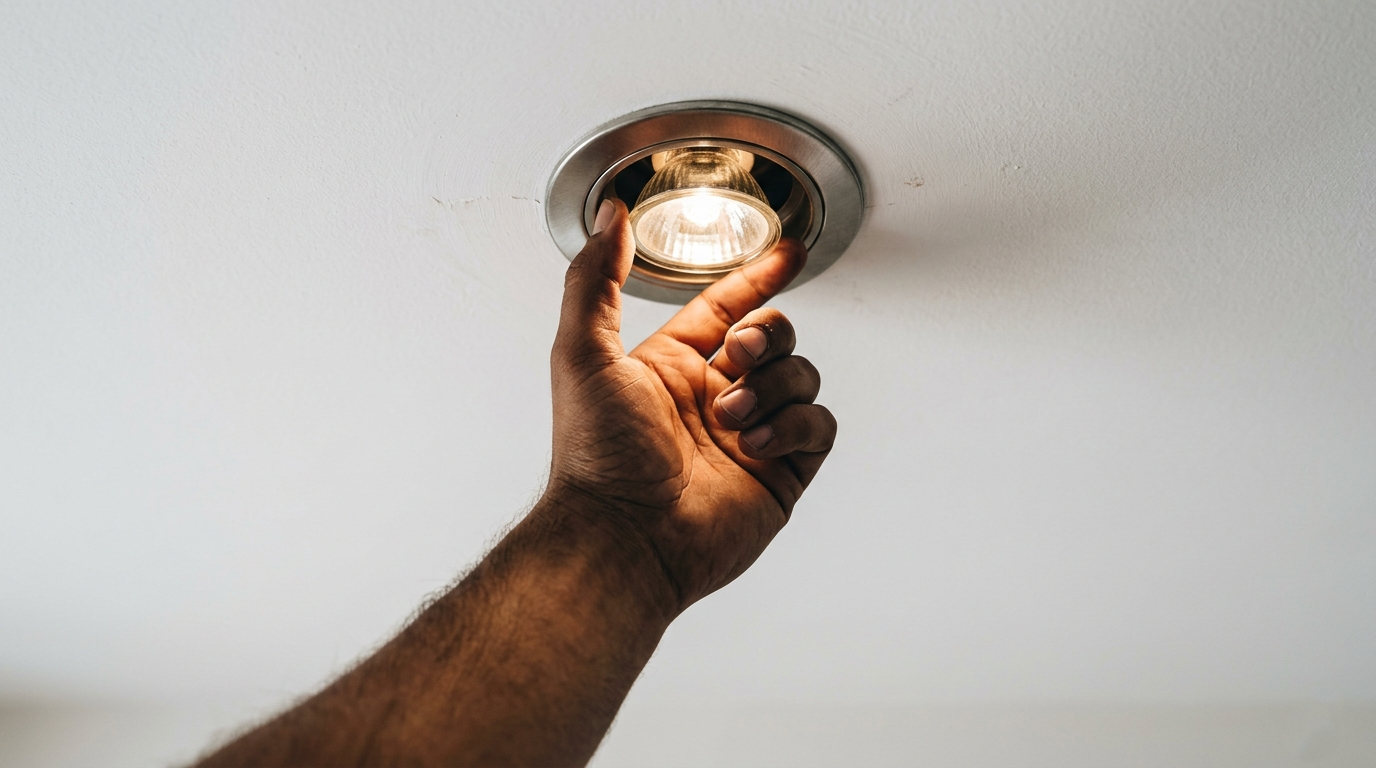
Queensland homeowners can legally replace a downlight globe themselves, but replacing the fitting — including integrated LED units — is electrical work that must be carried out by a licensed electrician. Here's exactly where the law draws the line, what the $14,375 maximum penalty for unlicensed work looks like, and why the compliance and insurance implications make getting it right the only sensible option.
Can You Replace Downlights Yourself in Queensland? What the Law Actually Says
Replacing downlights yourself in Queensland sounds like a straightforward job until you look at what the law actually permits. The globe has blown, the fitting looks accessible, and there are plenty of tutorials online. What most Brisbane homeowners don't realise is that there's a clear legal line between what they can do themselves and what requires a licensed electrician — and the consequences of crossing it go well beyond a fine.
With over 10 years of experience and 2,000-plus electrical jobs completed across Brisbane, the team at Exclusive Electrical & Air gets asked this question regularly. We've also been called to properties where someone got it wrong. In one case in Kenmore, three non-compliant wiring connections were identified during a pre-sale inspection after a previous owner had replaced integrated LED fittings themselves, requiring full remediation before settlement could proceed.
Here's exactly what Queensland law permits, where the line is, and why it matters more than most people realise.
Can You Replace Downlights Yourself in Queensland?
Queensland homeowners can legally replace a globe or lamp in an existing downlight fitting. Replacing the fitting itself, handling wiring, or replacing a transformer are all classified as electrical work under the Electrical Safety Act 2002 (Qld) and must be carried out by a licensed electrician. The distinction sounds simple. In practice, several common scenarios blur the line significantly.
Queensland Law on Electrical Work: What Governs DIY Downlight Jobs
Electrical work in Queensland is regulated under the Electrical Safety Act 2002 (Qld) and the Electrical Safety Regulation 2013 (Qld). These pieces of legislation define what constitutes electrical work, who is permitted to carry it out, and what the penalties are for unlicensed work.
The starting position under Queensland law is clear. Electrical work must be carried out by a licensed electrician. The legislation does, however, carve out a specific and intentionally narrow category of work that a homeowner can legally perform on their own property without a licence.
What Can Queensland Homeowners Legally Do Themselves?
The Electrical Safety Regulation 2013 (Qld) permits homeowners to carry out certain minor electrical tasks on their own property without a licence. For downlights, the relevant permitted activity is replacing a lamp — meaning a globe or bulb — in an existing fitting.
That's it. Replacing the globe itself, in an accessible fitting, on your own property, is legal for a Queensland homeowner to do without an electrician.
What that permission does not extend to includes:
Removing or replacing the downlight fitting itself
Disconnecting or reconnecting any wiring connected to the mains power circuit
Replacing a transformer associated with a low-voltage downlight system
Installing a new downlight fitting where one did not previously exist
Any work that requires accessing the wiring behind or above the fitting
Each of those tasks constitutes electrical work under Queensland law and must be carried out by a licensed electrician holding a current Queensland electrical contractor or worker licence.
If you've just realised the job you were planning to do yourself sits outside that permitted scope, you're not alone. Most Brisbane homeowners don't know where the line is until they look it up.
📞 0468 813 833 | INTERNAL LINK: Book Your Downlight Replacement
Same-week availability across Brisbane. Clear pricing, proper compliance documentation, workmanship warranty on every job. 10+ years experience. 2,000+ Brisbane customers. Licensed Queensland Electrical Contractor.
Where DIY Downlight Work Becomes Illegal in Queensland
Three specific scenarios cause the most confusion for Brisbane homeowners considering DIY downlight work.
Integrated LED Downlights
This is the most common point of confusion for Brisbane homeowners upgrading from halogen to LED. Many modern LED downlights are integrated fittings — the LED module and driver are built into the unit as a single component, with no separate replaceable globe. When the LED module reaches the end of its life, the entire fitting is replaced.
Replacing an integrated LED fitting is not a globe replacement. It is fitting replacement, which constitutes electrical work under Queensland law and requires a licensed electrician. Newer builds across Chermside, Aspley, and North Lakes where integrated LED fittings are standard from the original construction fall squarely into this category. The fact that some integrated fittings clip in and out relatively easily does not change the legal classification of the work.
MR16 Globe Replacement and Transformer Compatibility
MR16 halogen globes run on 12 volts via a transformer mounted in the ceiling space. Replacing an MR16 globe with an LED equivalent is, on the face of it, a permitted globe swap. However, many MR16 transformers are not compatible with LED globes, causing flickering, reduced globe life, or complete failure.
The transformer itself cannot be touched by a homeowner. Replacing or adjusting a transformer constitutes electrical work. A homeowner in Paddington or Ashgrove with an older halogen system who replaces an MR16 globe, discovers it flickers due to transformer incompatibility, and then attempts to address the transformer has crossed the line into unlicensed electrical work.
Accessing the Ceiling Space
Some downlight fittings require accessing the ceiling space to remove them or reach the wiring connection. Any work in the ceiling space that involves handling wiring or electrical components beyond the globe itself is not within the scope of permitted homeowner work. If the job requires more than reaching up to the fitting from below and swapping the globe, an electrician is required.
Why Queensland's Electrical Licensing Laws Are Strictly Enforced
Queensland's electrical licensing requirements exist because mistakes in residential electrical work cause fires and fatalities. The Electrical Safety Act 2002 (Qld) was introduced in a legislative environment that had documented the consequences of substandard electrical work in homes, and the restrictions on homeowner DIY reflect a considered judgement about where the risk threshold lies.
For downlights specifically, the fire risk associated with incorrect installation — particularly in homes with ceiling insulation — reinforces why fitting replacement is not a job for an unlicensed person. An incorrectly installed fitting, a wiring connection made incorrectly, or a fitting installed without the appropriate IC-F rating in an insulated ceiling are all outcomes that a licensed electrician is trained to avoid and that a homeowner working from a tutorial may not recognise as problems until something goes wrong.
There is also a practical insurance consideration. A homeowner who carries out unlicensed electrical work and subsequently experiences a fire or electrical fault may find their insurer unwilling to meet the claim. Home and contents policies typically exclude damage caused by illegal modifications or non-compliant work.
Smart switches and home automation are worth mentioning here too. Increasingly, Brisbane homeowners are asking whether they can install smart switches or smart dimmers themselves. Smart switch installation involves connecting to the mains circuit and is classified as electrical work under Queensland law — the same rules apply regardless of how the product is marketed.
Penalties for Unlicensed Electrical Work in Queensland
Queensland takes unlicensed electrical work seriously, and the penalties reflect that.
Under the Electrical Safety Act 2002 (Qld), carrying out electrical work without the appropriate licence attracts significant financial penalties. As of 2026, the maximum penalty for an individual carrying out unlicensed electrical work is 100 penalty units. With one Queensland penalty unit equal to $143.75 in 2026, that translates to a maximum penalty of $14,375 for an individual. The penalty applies to the person doing the work — a homeowner who carries out unlicensed work on their own property is not exempt.
Inspections by the Electrical Safety Office Queensland can be triggered by complaints, insurance claims, or property transactions that bring existing electrical work to scrutiny.
What Is a Compliance Certificate and Why Does It Matter?
When a licensed electrician carries out electrical work in Queensland, they are required to issue a Compliance Certificate — formally known as an Electrical Safety Certificate — for work that meets the relevant threshold. This document confirms the work has been carried out by a licensed professional and meets the applicable Australian Standards.
For a homeowner who has had unlicensed electrical work carried out, either by themselves or by an unlicensed tradesperson, there is no Compliance Certificate. This creates a gap in the property's electrical compliance record that becomes relevant in several situations.
At sale time, a licensed electrician carrying out a pre-sale inspection or renovation will identify and flag non-compliant previous work. In homes across Kenmore, Indooroopilly, and The Gap where whole-home downlight replacements have been carried out by previous owners, this is not a hypothetical — it happens. The consequences can include remediation costs at the vendor's expense, delays to settlement, and impact on the sale price. Getting it right the first time is significantly less expensive than fixing it under time pressure before settlement.
For rental properties, the same rules apply with an additional liability dimension. Landlords who have non-compliant electrical work in a rental property carry exposure under Queensland's residential tenancy laws, separate from the penalties under the Electrical Safety Act. A tenant living with non-compliant electrical work creates a situation that no landlord wants to be in.
Why a Licensed Electrician Is the Smarter Call for Brisbane Downlight Jobs
For many Brisbane homeowners, the calculation on DIY versus licensed electrician looks straightforward on the surface: save the labour cost by doing it yourself. The reality is more nuanced.
A licensed electrician replacing downlight fittings is not just swapping hardware. They are assessing the condition of the existing wiring at each fitting location, confirming that the new fittings are rated appropriately for the installation environment, ensuring transformer compatibility where relevant, and identifying any issues with the existing installation that represent a safety or compliance concern.
For a standard LED downlight installation Brisbane, the per-fitting cost of a licensed electrician typically sits between $80 and $140 installed, including compliance documentation. For a whole-home LED upgrade involving ten or more fittings across a Brisbane home, that per-fitting cost is modest relative to the total job value — and the outcome is a compliant installation backed by a Compliance Certificate that protects the homeowner's insurance position and property value.
The same rules apply to commercial premises. Business owners who carry out or commission unlicensed electrical work face the same penalties under the Electrical Safety Act, with the additional dimension of potential Work Health and Safety Act implications for non-compliant electrical work in a workplace.
If you've already replaced a fitting yourself, it's worth having a licensed electrician assess the work before it becomes a problem at sale time or during an insurance claim.
FAQ
Can I replace a downlight globe myself in Queensland?
Yes. Replacing a lamp or globe in an existing fitting is a permitted homeowner activity under the Electrical Safety Regulation 2013 (Qld). This applies to accessible GU10 and MR16 globe replacements. It does not extend to replacing the fitting itself, handling wiring, or replacing transformers.
Can I replace a downlight fitting myself in Queensland?
No. Replacing a downlight fitting constitutes electrical work under Queensland law and must be carried out by a licensed electrician. This applies regardless of how simple the physical process appears. Integrated LED fittings, which have no separate replaceable globe, also fall into this category. Find out more about [INTERNAL LINK: LED downlight upgrade Brisbane | destination: LED downlight installation service page].
What happens if I do my own electrical work in Queensland without a licence?
Carrying out unlicensed electrical work in Queensland is a breach of the Electrical Safety Act 2002 (Qld) and carries a maximum penalty of $14,375 for an individual as of 2026. It also creates insurance exposure, as home and contents policies typically exclude damage caused by unlicensed or non-compliant electrical work.
Do I need a Compliance Certificate for downlight replacement in Brisbane?
A Compliance Certificate is required for electrical work that meets the relevant threshold under Queensland law. A licensed electrician will advise whether a certificate is required for the specific scope of work and issue one where applicable. Work carried out by an unlicensed person cannot be certified.
Can I hire a handyman to replace downlights in Queensland?
No. A handyman who is not a licensed electrician cannot legally replace downlight fittings or carry out any electrical work beyond the same limited scope permitted to homeowners. Engaging an unlicensed person to carry out electrical work creates the same legal and insurance risks as doing it yourself.
Is it legal to replace my own downlights in Queensland if I turn the power off first?
No. Turning the power off at the switchboard reduces the immediate electrocution risk but does not change the legal classification of the work. Replacing a fitting is still electrical work under Queensland law regardless of whether the circuit is isolated, and it still requires a licensed electrician.
How do I verify that an electrician is licensed in Queensland?
Licensed Queensland electrical contractor credentials can be verified through the QBCC licence register. A licensed Queensland electrical contractor is the appropriate professional for any downlight fitting replacement or LED upgrade.
Book Your Brisbane Downlight Replacement — Done Properly, Once
The permitted scope for homeowner electrical work in Queensland is narrow for good reason, and downlight fitting replacement sits clearly outside it. For globe swaps in straightforward accessible fittings, a homeowner can legally proceed. For anything beyond that, a licensed electrician is both legally required and the better outcome for the property.
At Exclusive Electrical & Air, we carry out LED downlight upgrades across all Brisbane suburbs with clear pricing, proper compliance documentation, and the full assessment that ensures the job meets Queensland's electrical standards. Every installation is covered by a Certificate of Testing and Compliance. Workmanship warranty included on every job.
And while your electrician is in your ceiling space, it's also worth asking them to check your smoke alarm compliance ahead of Queensland's 1 January 2027 deadline — one visit, two compliance issues resolved.
📞 0468 813 833 | Book Your Downlight Replacement
Rated 5 stars by Brisbane homeowners on Google. 10+ years experience. 2,000+ Brisbane customers. Licensed Queensland Electrical Contractor. Workmanship warranty on every installation.