What Happens to Your Solar System During a Brisbane Storm?
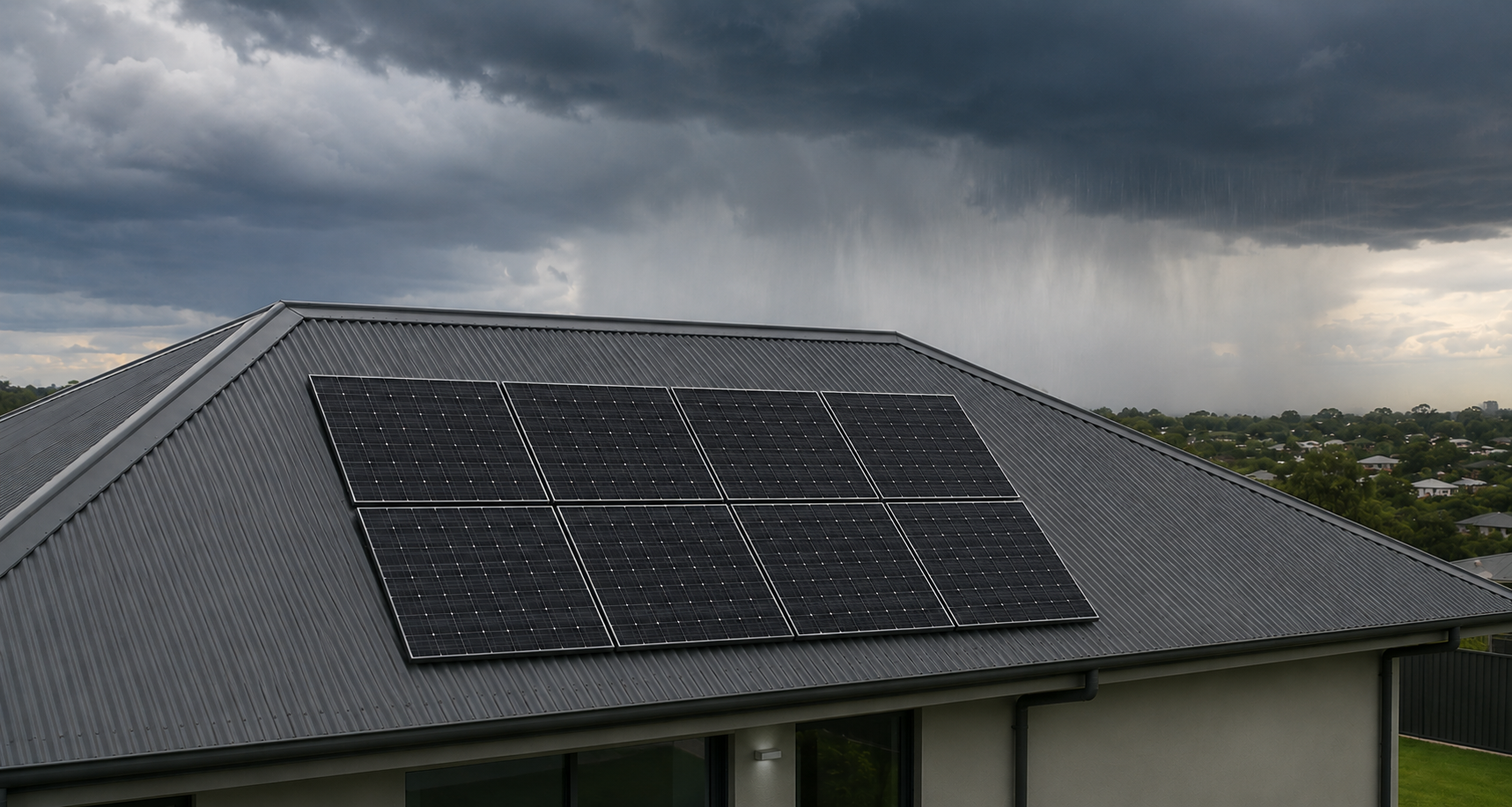
Your solar system does not simply ride out a Brisbane storm unaffected. Modern inverters are designed to shut down automatically when the grid drops, but lightning surges, physical panel damage, and post-storm performance issues are all genuine risks that Brisbane solar households should understand before storm season arrives.
What Happens to Your Solar System During a Brisbane Storm?
Brisbane's storm season is one of the most electrically active weather patterns in Australia. Between October and March, South East Queensland regularly experiences severe thunderstorms delivering lightning strikes, high winds, large hail, and the kind of voltage surges that travel through power lines and into homes well beyond the immediate strike zone. For the growing number of Brisbane households with rooftop solar, each of those storm characteristics represents a specific risk to equipment that sits outdoors, connects directly to your switchboard, and in the case of the inverter, costs several thousand dollars to replace.
Understanding what your solar system actually does during a storm, what can go wrong, and what to look for in the aftermath is practical knowledge for any Brisbane solar household. It is also the kind of information that shapes sensible decisions about surge protection, insurance, and post-storm inspection before the next severe weather event arrives.
Exclusive Electrical & Air is a Clean Energy Council accredited solar installer that has been working with Brisbane homeowners for over a decade, serving more than 2,000 residential and commercial customers across suburbs including Kenmore, Hamilton, Toowong, Chermside, and Aspley. The team's experience with post-storm solar inspections and surge-related inverter failures across Brisbane's housing stock forms the basis of what follows.
What the Inverter Does When a Storm Hits
The first thing to understand is that your solar system is not designed to operate independently during a grid outage. Standard grid-connected solar inverters, which cover the overwhelming majority of residential solar installations in Brisbane, are required by Australian Standards to shut down automatically the moment grid power is lost. This is called anti-islanding protection, and it is a deliberate safety mechanism rather than a fault.
The reason for it is straightforward. If a solar inverter continued generating and exporting power during a grid outage, it would be feeding live voltage into lines that network workers and emergency personnel may be treating as de-energised. Anti-islanding prevents this by cutting the inverter's output the moment grid voltage disappears, and the inverter remains offline until the grid is restored and stable.
For Brisbane solar households, this means that a storm-related grid outage results in the loss of solar generation for the duration of the outage, regardless of how much sunlight is available. This applies equally to homes with battery storage in most standard configurations, unless the battery system is specifically set up for islanding or backup mode with the appropriate hardware and configuration.
Once the grid is restored and the inverter detects that supply has stabilised within the correct voltage and frequency parameters, it reconnects and resumes generation automatically. This process typically takes between one and five minutes following grid restoration and requires no action from the homeowner.
The Bigger Risk: Voltage Surges and Lightning
Grid outages during a storm are a disruption. Voltage surges are a damage risk, and the distinction matters considerably.
Lightning does not need to strike your property directly to send a surge through your solar system. A strike within several hundred metres that hits power lines or ground infrastructure can inject a voltage spike into the distribution network that travels directly into your home's electrical system via the grid connection. Your solar inverter sits at the intersection of the grid connection and your home's internal circuits, which makes it particularly exposed to any surge arriving from either direction.
The consequences of a significant surge event for a solar inverter range from degraded performance and reduced lifespan at the minor end to complete and immediate failure at the severe end. Inverter replacement costs for quality residential units typically sit between $1,500 and $3,000 or more before labour and any associated inspection work. For a solar system that is otherwise in good condition, an unprotected inverter failure is an entirely avoidable expense.
Bureau of Meteorology Queensland thunderstorm data
Surge protection for solar systems involves installing a surge protective device at the switchboard that intercepts excess voltage before it reaches the inverter and other downstream equipment. This is the same principle as whole-home surge protection, and for properties with solar the inverter represents one of the most compelling reasons to have it in place before storm season.
AS/NZS 1768 Lightning protection
The installation of a surge protective device at the switchboard is notifiable electrical work under the Electrical Safety Regulation 2013 QLD and must be carried out by a licensed electrician. For Brisbane solar households without switchboard surge protection currently in place, arranging this before the storm season peak is a straightforward investment relative to the replacement cost of an unprotected inverter.
Switchboard upgrades and surge protection Brisbane
Call +61 468 813 833 to arrange a switchboard assessment and surge protection installation before the next storm season peak.
Physical Risks: Panels, Mounting, and Roof Penetrations
Beyond the electrical risks, Brisbane storms present physical risks to the solar installation itself that are worth understanding.
Hail is the most obvious physical threat to solar panels. Modern solar panels are tested to withstand hailstones up to 25 millimetres in diameter under Australian Standards, and the majority of Brisbane hail events fall within or below that range. Larger hailstones, which do occur in severe South East Queensland storm cells, can crack or shatter panel glass, reducing output and in some cases compromising the panel's weatherproofing integrity.
Visible cracks, chips, or shattered sections of panel glass are straightforward to identify from ground level after a storm. Less visible is micro-cracking, where the internal cell structure of a panel is damaged without obvious external signs. Micro-cracked panels continue to generate electricity but at reduced output, and the damage tends to worsen over time. A post-storm performance check, comparing actual generation figures against expected output for the conditions, can identify panels that have been degraded without obvious visible damage.
High winds present a risk to mounting hardware and roof penetrations. Solar panel mounting systems are engineered and installed to specified wind ratings, but extreme wind events can shift or loosen panels if mounting points were not correctly installed at the time of the original job, or if mounting hardware has corroded or degraded over the system's life. After a severe wind event, checking that panels are visibly seated correctly in their frames and that no mounting components appear displaced is a sensible precaution.
Roof penetrations used for conduit and cable routing should also be inspected after significant storms. Water ingress through deteriorated flashing or sealant around penetrations can affect both the roof structure and the cable runs beneath, creating issues that are not immediately visible but develop over time.
What to Do After a Significant Storm Event
The post-storm check for a Brisbane solar household follows a logical sequence.
Start with a visual inspection from ground level. Check for visible panel damage including cracks, chips, or dislodged panels. Confirm the inverter is operational by checking its display. Most modern inverters show current generation status on a front-facing display or via a monitoring app. If the inverter is showing a fault code or has not resumed generation following grid restoration, that warrants a call to a licensed electrician.
Check your monitoring data if your system includes remote monitoring capability. A drop in generation output relative to similar days before the storm is worth investigating, even in the absence of visible damage.
If your home experienced a grid outage during the storm and power was restored, confirm that the inverter has reconnected correctly. If it has not resumed generation within a reasonable period of grid restoration, a fault has occurred and should be assessed.
For any situation where the inverter is displaying a fault code, panels are visibly damaged, or generation data indicates a performance decline following a storm event, the appropriate response is a post-storm inspection by a licensed electrician and accredited solar installer. Attempting to inspect or access solar equipment on a roof or within the inverter enclosure without appropriate qualifications is unsafe and is regulated under the Electrical Safety Act 2002 QLD.
Solar panel installation and assessment Brisbane
FAQ
Q: Will my solar system keep working during a power outage caused by a Brisbane storm?
A: A standard grid-connected solar system will not generate during a grid outage due to mandatory anti-islanding protection. Homes with battery storage systems configured for backup or islanding mode may retain power to specified circuits during an outage, depending on the battery system's hardware and configuration.
Q: Does home and contents insurance cover storm damage to solar panels?
A: Many home and contents policies include solar panels as part of the building or contents cover, but sub-limits, exclusions, and excess amounts vary significantly between policies. Checking your policy's specific provisions for solar equipment before storm season arrives is strongly recommended. A post-storm inspection report from a licensed electrician supports any insurance claim requiring documentation of the damage.
Q: How do I know if my solar inverter was damaged by a surge if it is still turning on?
A: Surge damage does not always result in immediate complete failure. A surge-affected inverter may continue to operate but with degraded performance, reduced output capacity, or increased fault frequency over time. If your system's generation figures have declined following a significant storm event without an obvious cause, a professional inverter assessment is worthwhile.
Q: Can I install surge protection on my solar system without a full switchboard upgrade?
A: Surge protective devices are installed at the switchboard by a licensed electrician and do not necessarily require a full switchboard upgrade. The electrician assesses the switchboard condition and available installation points as part of the surge protection job. Where the switchboard is in suitable condition, a surge protective device can often be added without a full board replacement.
Q: What is the most common solar-related call Exclusive Electrical & Air receives after a Brisbane storm?
A: Inverter faults and generation performance drops are the most frequent post-storm solar calls. Some result from surge events that have affected the inverter's electronics. Others are caused by a grid outage and recovery sequence that has left the inverter in a fault state requiring a reset or inspection to resolve.
Brisbane storms are not gentle with electrical equipment, and a solar inverter on an unprotected system is one of the more expensive things that can fail in a single weather event. Getting surge protection in place before storm season and knowing what to check in the aftermath are both straightforward steps for any Brisbane solar household.
Exclusive Electrical & Air is a Clean Energy Council accredited solar installer and licensed electrician team serving all Brisbane suburbs, from Kenmore and Indooroopilly in the west to Chermside, Hamilton, and Aspley in the north. All inspection, surge protection, and solar assessment work is carried out by licensed electricians and backed by a workmanship warranty.
Call +61 468 813 833 or book online at https://www.exclusiveqld.com.au/connect to arrange a pre-storm solar and surge protection assessment for your property.