What Size Solar System Does a Brisbane Home Actually Need?
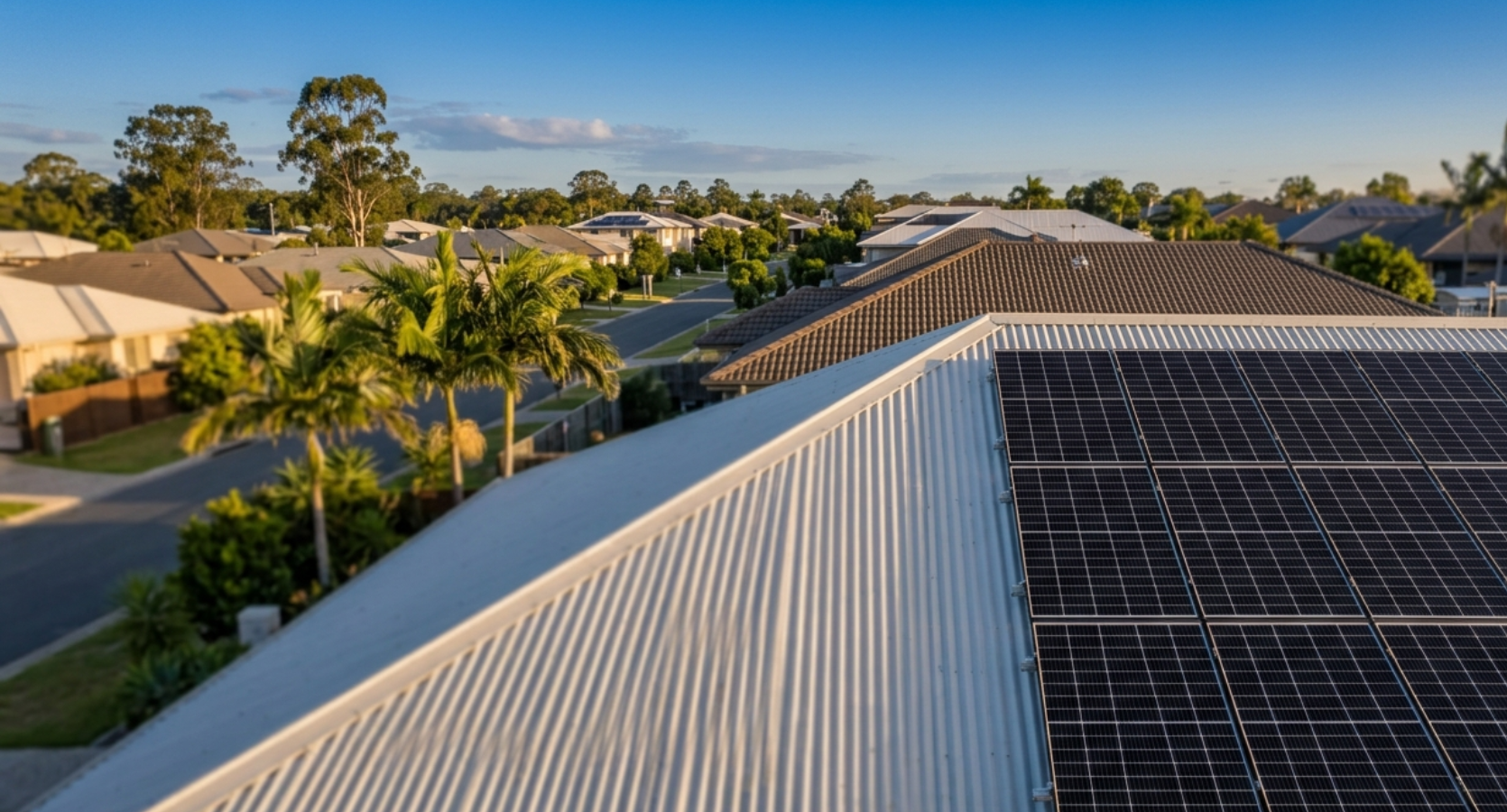
Choosing the right solar system size for a Brisbane home comes down to actual household consumption, when that energy is used, and what the roof can accommodate — not a default package recommendation. A 3 to 5kW system suits smaller households, 6.6kW suits most Brisbane families of three to four, and 10kW or above suits high-consumption homes with pools, EVs, or ducted air conditioning. Here's how to work through the sizing decision properly, with generation benchmarks, cost ranges, and household profiles for 2026.
What Size Solar System Does a Brisbane Home Actually Need? A Practical Guide
The most common solar sizing mistake Brisbane homeowners make isn't installing a system that's too small. It's installing one that's too large for their actual consumption patterns, then wondering why the financial return doesn't match what they were sold on.
System size is where solar conversations in Brisbane tend to default to a standard answer — 6.6kW — without enough thought about whether that answer actually suits the household being asked. For some Brisbane homes, 6.6kW is exactly right. For others, it's an oversized system generating significant export at low feed-in tariff rates when a smaller, better-matched system would have delivered a better return. For others still, 6.6kW is genuinely undersized and leaves meaningful savings on the table.
With over 10 years of experience and 2,000-plus electrical and solar jobs completed across Brisbane, Exclusive Electrical & Air is a Clean Energy Council accredited installer and licensed Queensland electrical contractor. We size every system based on actual consumption data, not a default package. Working out what size solar system your Brisbane household actually needs requires looking at three things: how much electricity you consume, when you consume it, and what your roof can physically accommodate.
What Size Solar System Do I Need in Brisbane?
The right solar system size for a Brisbane home depends on daily electricity consumption, when that energy is used, and available roof space. As a starting guide: a 3 to 5kW system suits one to two person households, 6.6kW suits most families of three to four, and 10kW or above suits high-consumption homes with pools, ducted air conditioning, or electric vehicles.
Solar System Sizing Brisbane: Start With Your Consumption
Here's how daily electricity consumption typically compares across different Brisbane household sizes in 2026. A one to two-person household generally uses between 8 and 15 kWh per day. Most three to four-person households consume around 15 to 25 kWh per day, while larger households with five or more occupants typically use 25 to 40 kWh per day. Homes with higher electricity demands, such as those with a swimming pool, electric vehicle, or ducted air conditioning, often consume 30 to 50 kWh per day. These figures are indicative only, as actual usage depends on factors such as appliance efficiency, home size, whether cooking and hot water are gas or electric, and the household's lifestyle.
These are indicative ranges. Actual consumption varies significantly based on the age and efficiency of appliances, whether the home has gas or electric cooking and hot water, the size of the property, and lifestyle factors specific to the household.
If your electricity retailer provides interval meter data — half-hourly consumption records — that's significantly more useful than a daily average. Interval data shows not just how much you consume but when, which is critical for understanding how much of your consumption occurs during solar generation hours versus evening and overnight.
Why When You Use Power Matters for Solar Sizing in Brisbane
A household that consumes 25 kilowatt-hours per day but uses 70 percent of that in the evening and overnight gets fundamentally different value from a solar system than a household with the same total consumption that runs appliances, air conditioning, and a pool pump during the day.
Solar panels generate energy between approximately 7am and 5pm in Brisbane, with peak output occurring between 10am and 2pm. Energy consumed during those hours is offset directly by solar generation — it's the most valuable use of every kilowatt-hour the panels produce. Energy consumed outside those hours either draws from a battery if one is installed, or comes from the grid at full retail rates regardless of how much solar the system generates.
A household in Paddington or Newstead where adults are at work and children are at school during the day, with minimal daytime appliances running, will export a large proportion of its solar generation at the feed-in tariff rate — currently 5 to 10 cents per kilowatt-hour for most Queensland households per the Queensland Competition Authority electricity price monitoring. That household gets far less value from a large system than the same kilowatt-hours consumed directly would provide.
Understanding your daytime consumption — the portion of your daily usage that occurs while panels are generating — is the key variable for sizing. If you don't have interval data, a reasonable estimate can be made by considering which appliances run during the day and their rated wattage.
How Much Power Does Each Solar System Size Generate in Brisbane?
A well-oriented, unshaded 3kW solar system in Brisbane typically costs between $3,500 and $5,000 to install. It generally produces around 4,400 to 4,900 kWh of electricity per year, or approximately 12 to 13 kWh per day.
A 5kW system usually costs $5,000 to $7,500 and generates approximately 7,300 to 8,200 kWh annually, equating to around 20 to 22 kWh per day.
The popular 6.6kW system typically costs between $6,500 and $9,500. Under Brisbane conditions, it can generate approximately 9,600 to 10,800 kWh each year, or around 26 to 30 kWh per day.
For higher-consumption households, a 10kW system generally costs $9,500 to $14,000 and produces around 14,600 to 16,400 kWh annually, which works out to approximately 40 to 45 kWh per day.
A larger 13.3kW system usually costs between $13,000 and $18,000. It can generate approximately 19,300 to 21,700 kWh per year, or around 53 to 59 kWh each day.
These estimates assume a north-facing roof with minimal shading. East or west-facing installations generally produce 15 to 20 percent less energy than an equivalent north-facing system.
STCs — the federal rebate reducing upfront system cost — are calculated based on system size. A 10kW system generates more STCs than a 6.6kW system, partially offsetting the higher panel and installation cost. An accredited installer calculates the STC value for each system size being compared, so ask for this figure at the quoting stage.
For Brisbane homes with partial shading constraints — common in older properties in Ashgrove, Bardon, and Taringa with established tree cover — microinverter or DC optimiser systems can reduce the impact of shading on overall output, which can change the practical sizing calculation by allowing more of the available roof space to contribute effectively.
What Solar System Size Does Your Brisbane Household Actually Need?
Single Person or Couple, Low to Moderate Consumption
A one or two-person household consuming 8 to 12 kilowatt-hours per day, with some daytime appliance use but primarily evening consumption, is typically well served by a 3kW to 5kW system. Oversizing to 6.6kW generates significantly more than the household can use, with the surplus exported at low feed-in tariff rates. The additional panels add cost without delivering proportional financial return.
Family Household, Moderate Consumption
A three or four-person household consuming 18 to 25 kilowatt-hours per day, with appliances running through the day including a dishwasher, washing machine, and air conditioning during Brisbane's long warm season, is the household profile that aligns most closely with a 6.6kW system. It's a well-matched system for this profile, which is why it has become the de facto standard recommendation across the Queensland market.
High-Consumption Household
A large family household or a home with a pool, ducted reverse-cycle air conditioning, electric hot water, and potentially an electric vehicle consuming 30 to 50 kilowatt-hours per day has consumption that a 6.6kW system cannot meaningfully offset. For these households, a 10kW to 13.3kW system is more appropriate.
We recently sized a system for a family in Kenmore — two adults, two teenagers, ducted air conditioning, a pool pump, and plans to add an EV within two years. Their daily consumption was 32kWh with significant daytime use. The right answer was 10kW, not the standard 6.6kW that several other installers had quoted them without reviewing consumption data.
Household Planning to Add a Battery
For households planning to add solar battery storage Brisbane now or in the future, system sizing should account for the additional generation required to charge the battery as well as meet daytime consumption. A household planning to add a 10kWh battery should size the solar system to generate enough energy to cover daytime consumption plus battery charging, which often pushes the appropriate system size up by 2 to 3kW compared to a solar-only installation.
Future-Proofing Your System Size
Households planning to add an EV, a pool, or battery storage within two to three years should factor those additions into system sizing now. Adding 2 to 3kW to the initial system to accommodate planned future loads is typically more cost-effective than retrofitting panels later, and the additional STC value on a larger initial system partially offsets the extra panel cost.
You've just identified which household profile fits yours. The next step is a consumption analysis based on your actual data rather than a category estimate.
📞 0468 813 833 | Book Your Solar Sizing Assessment
We'll tell you honestly if a smaller system suits your household better. The right size system outperforms an oversized one every time, and our assessment reflects that. Free on-site assessment. No obligation. Clean Energy Council accredited. Licensed Queensland Electrical Contractor.
Energex Single-Phase Limits: What Brisbane Homeowners Need to Know
Most Brisbane homes are connected to a single-phase electricity supply, and Energex — the distribution network operator for south-east Queensland — currently permits a maximum inverter export capacity of 5kW on a single-phase connection under a standard network connection.
This creates a common Brisbane solar configuration: a 6.6kW panel array connected to a 5kW inverter. The panel capacity exceeds the inverter capacity by approximately 33 percent, which is an accepted and widely used configuration. The additional panel capacity accounts for real-world factors including panel orientation, temperature effects on output, and shading, ensuring the inverter operates at or near its rated capacity during peak generation periods.
For households wanting to go beyond this configuration, options include applying for an increased export limit from Energex, which is assessed on a network capacity basis and is not guaranteed, or installing a larger system with export limiting applied, where the additional generation is consumed within the home rather than exported. A switchboard upgrade Brisbane may also be required for larger systems depending on the existing electrical infrastructure. Three-phase connected homes, more common in newer estates like North Lakes and Springfield, can accommodate larger inverters and systems without these constraints.
Understanding your network constraints before choosing a system size is the kind of detail that changes the right answer. Get it confirmed by a licensed electrician before you commit.
📞 0468 813 833 | Book Your Solar Sizing Assessment
STC incentives reduce in value each year as the 2030 scheme end date approaches. Sizing and installing your system sooner locks in a higher rebate on the same system. 10+ years experience. 2,000+ Brisbane customers.
How Much Roof Space Does a Solar System Need in Brisbane?
Roof space requirements vary depending on the system size. A 6.6kW solar system using 415W panels typically requires 16 panels, occupying approximately 32 to 35 square metres of roof space.
A 10kW system generally requires 24 panels, with an estimated roof area of 48 to 52 square metres.
A 13.3kW system typically uses 32 panels and requires approximately 64 to 70 square metres of available roof space.
These estimates include sufficient clearance for panel mounting and installation requirements.
For Brisbane homes with limited north-facing roof space — including compact inner-city properties in West End, Newstead, and Teneriffe — the physically available space may constrain the system size below what consumption analysis would suggest. In these situations, the assessment should identify the maximum practical system size for the available roof and design the layout to maximise output from that space.
East and west-facing panels generate approximately 15 to 20 percent less than a north-facing equivalent. Split arrays across east and west faces can spread generation across more of the day, which suits households with consumption spread across morning and afternoon.
Commercial Sizing
Commercial solar sizing follows the same consumption-first logic but with additional factors — demand tariff structure, phase supply, roof structural certification requirements, and Energex network application processes for larger systems. A licensed commercial electrician and accredited installer should conduct the consumption analysis and system design for any commercial premises.
FAQ
What size solar system do I need for a 3-bedroom house in Brisbane?
It depends on household consumption and daytime usage patterns. A three-bedroom home occupied by two to three people with average consumption of 15 to 20 kilowatt-hours per day is typically well served by a 5kW to 6.6kW system in Brisbane. Larger households or those with pools, ducted air conditioning, or electric vehicles may need 10kW or more. Find out more about solar panel installation Brisbane.
Is a 6.6kW solar system enough for a Brisbane family?
For a typical three to four-person Brisbane family consuming 18 to 25 kilowatt-hours per day, a 6.6kW system is generally well matched. It generates sufficient energy to cover most daytime consumption with some export during peak generation periods. High-consumption households or those planning to add a battery may benefit from a larger system.
Can I install a system larger than 6.6kW on a single-phase connection in Brisbane?
Yes. Energex permits a maximum inverter export capacity of 5kW on a standard single-phase connection, but larger panel arrays can be installed with the additional capacity used for self-consumption rather than export. Systems significantly larger than 6.6kW on single-phase connections may require an export limiting arrangement or an application for an increased export limit.
Will a bigger solar system always give me a better return?
Not necessarily. A system significantly larger than your daytime consumption generates surplus energy exported at the low feed-in tariff rate, reducing the overall return on the additional panels. The best financial return comes from a system sized to match your actual daytime consumption, with any battery charging requirements also factored in.
How do I find out how much electricity my Brisbane home actually uses?
Your electricity bills show total consumption per billing period in kilowatt-hours. Dividing by the number of days gives a daily average. For more useful data, ask your electricity retailer for interval meter data showing half-hourly consumption patterns, which allows a more accurate assessment of daytime versus evening consumption.
Does roof orientation affect what size system I should install?
Yes. East and west-facing panels generate approximately 15 to 20 percent less than north-facing panels in Brisbane. A home with only east or west-facing roof space available may need a larger panel array to generate the same annual output as a smaller north-facing system. Split arrays across east and west faces can spread generation across more of the day, which suits households with consumption spread across morning and afternoon.
Get a Solar Sizing Assessment Based on Your Actual Consumption
The size of your solar system is one of the most consequential decisions in the installation process, and the right answer is specific to your household rather than a standard number applied across the board.
At Exclusive Electrical & Air, we size residential solar panel installation Brisbane based on actual consumption data, roof configuration, and household circumstances — not a default package. We'll review your interval meter data, assess your roof, and recommend the system size that genuinely suits your household. If a smaller system is the right answer, we'll tell you that.
📞 0468 813 833 | Book Your Solar Sizing Assessment
Rated 5 stars by Brisbane homeowners on Google. Clean Energy Council accredited. Licensed Queensland Electrical Contractor. 10+ years experience. 2,000+ Brisbane customers. Free assessment. No obligation.