Surge Protection for Brisbane Homes: Why Storm Season Changes Everything
Brisbane gets hit with some of Australia's most intense electrical storms, and every strike near your home puts your appliances, solar inverter, and smart devices at risk. A powerboard strip won't cut it. Here's what whole-home surge protection actually involves and why spring is the right time to sort it out.
Surge Protection for Brisbane Homes: Why Storm Season Changes Everything
Brisbane is one of the most storm-prone cities in Australia. Between October and March, South East Queensland regularly sees violent thunderstorms roll in off the ranges, delivering lightning strikes, voltage spikes, and enough electrical chaos to ruin thousands of dollars worth of appliances in a fraction of a second. For homeowners in suburbs like Chermside, Kenmore, The Gap, Mitchelton, and Bracken Ridge, this is not a seasonal inconvenience. It is a genuine electrical risk that catches most people off guard until something expensive stops working.
The problem is that most Brisbane homeowners believe the powerboard surge protector sitting under their television is doing the job. It is not. And by the time they find out, the damage is already done.
Exclusive Electrical & Air has been protecting Brisbane homes from power surges for over a decade. With more than 2,000 customers served across the city and a 5 star rating from Brisbane homeowners on Google, the team has seen firsthand what an unprotected home looks like after a direct lightning event or a major grid fluctuation. The answer is rarely pretty. 📞 0468 813 833.
This guide covers exactly what surge protection is, why Brisbane's storm season makes it critical, and what whole-home surge protection actually involves when installed by a licensed electrician.
What Is Whole-Home Surge Protection?
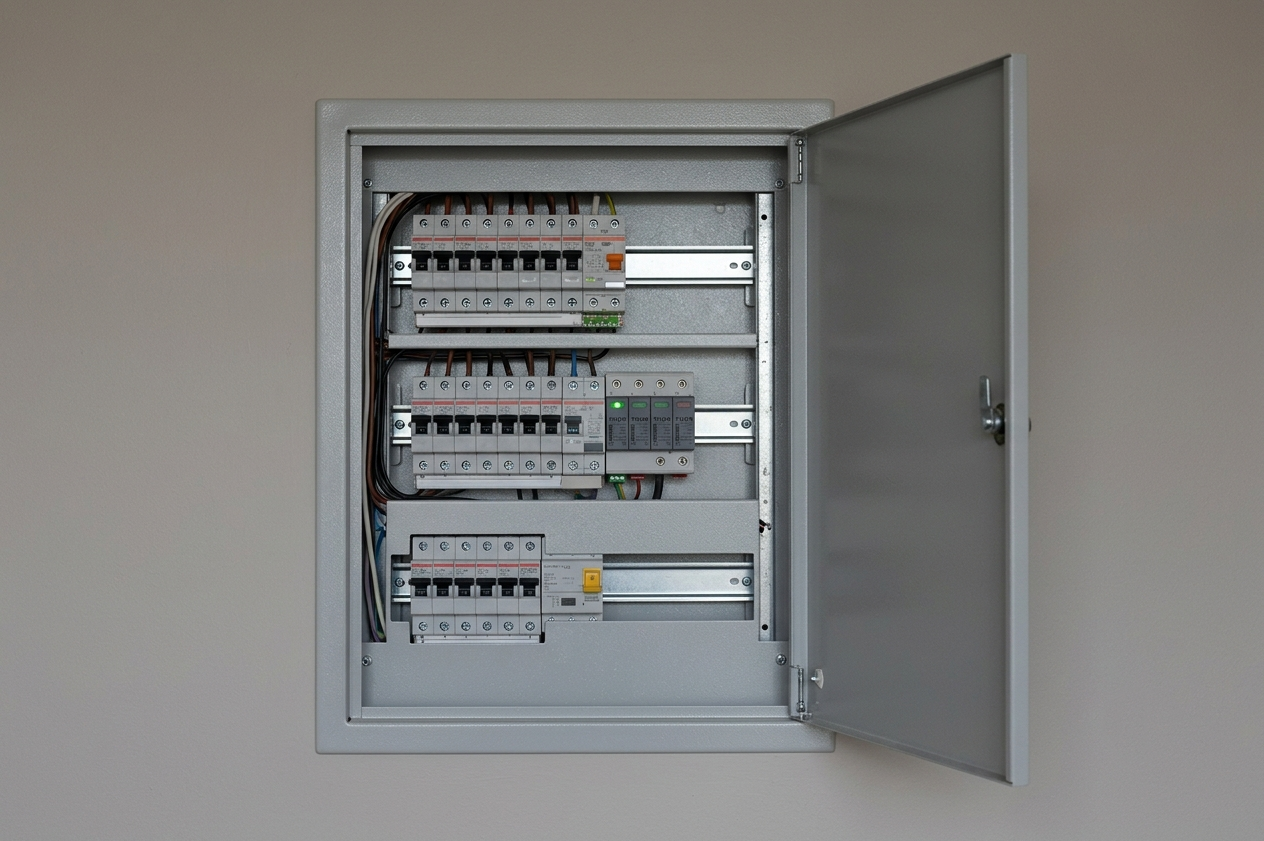
Whole-home surge protection involves installing a surge protective device (SPD) at your main switchboard, where it intercepts voltage spikes before they reach any circuit or appliance in your home. It is installed by a licensed electrician and rated to AS 1768:2021, the Australian lightning protection standard.
What Is a Power Surge and What Causes Surge Damage in Brisbane Homes?
A power surge is a sudden, short-duration spike in electrical voltage that exceeds the standard operating level of your home's circuits. In Australia, household voltage runs at 230 volts. A surge can drive that figure into the thousands of volts for milliseconds at a time. That brief spike is enough to damage or destroy the sensitive electronic components inside modern appliances, smart home devices, solar inverters, and air conditioning units.
There are two categories of power surges.
External surges originate outside your home. Lightning strikes are the most dramatic cause, but they do not need to hit your property directly. A strike within several hundred metres of your home can send a surge through the power lines connected to your switchboard. Grid switching by energy providers, downed power lines, and transformer faults are other common external sources.
Internal surges originate inside your home. Every time a high-draw appliance like an air conditioner, pool pump, or washing machine cycles on or off, it creates a small voltage fluctuation on your internal circuits. These micro-surges are far less dramatic than a lightning event, but they occur repeatedly throughout the day and cause cumulative damage to electronics over time. Many appliance failures that appear to be manufacturing defects are actually the result of months of internal surge damage.
Why Brisbane Homes Face a Higher Surge Risk Than Most Australian Cities
Queensland consistently ranks among the top states in Australia for lightning activity. The Bureau of Meteorology Queensland thunderstorm climate data records tens of thousands of lightning strikes across South East Queensland each storm season, with the inland western suburbs and northern corridors particularly exposed during the peak months of November through February.
Homes in elevated areas such as The Gap, Kenmore, and Toowong sit at greater exposure to direct strike proximity due to their position relative to the ranges. Older suburban areas like Mitchelton, Aspley, and Kedron often have established street tree canopies that increase lightning-conductor proximity to overhead power lines.
Even inner-Brisbane and riverside suburbs including Indooroopilly are not insulated from the risk when storms track across the river corridor.
Beyond geography, the nature of the modern Brisbane home makes the stakes considerably higher than they were twenty years ago. A typical household now includes smart TVs, laptops, gaming systems, smart home hubs, high-efficiency air conditioning systems with sophisticated inverter electronics, solar panels, battery storage systems, and in a growing number of cases, EV charging equipment. Each of these devices contains sensitive electronics that are highly vulnerable to surge damage. The replacement cost across a single household can easily run into tens of thousands of dollars.
Why a Powerboard Surge Protector Is Not Enough for Brisbane Storm Season
The plug-in surge protectors sold at hardware stores offer point-of-use protection only. They are designed to absorb a limited amount of surge energy at the specific outlet they are plugged into. They offer no protection to any other circuit in the home, no protection to hardwired appliances like air conditioning units and ovens, and no protection to your solar inverter or switchboard.
They also have a finite capacity. Once a powerboard surge protector absorbs its rated surge energy, it stops functioning as a surge protector. In most cases, there is no visible indicator that this has happened. The unit still allows power through. It just no longer protects anything.
For a home in Brisbane during storm season, a powerboard protector is the equivalent of putting a bucket under a roof leak. It might catch something in that one spot, but it is not solving the problem.
What Whole-Home Surge Protection Involves: Brisbane Switchboard Installation
Whole-home surge protection is installed at the switchboard by a licensed electrician and works by intercepting excess voltage before it reaches any circuit in your home.
A Type 2 SPD at the main switchboard handles large external surge events. For high-value equipment like home entertainment systems, computers, and solar monitoring hardware, a secondary Type 3 point-of-use device provides an additional layer. Together these form a coordinated protection system that addresses both dramatic external surges and quieter internal fluctuations.
The SPD works by diverting excess energy to earth. If the earthing system is inadequate or does not meet current standards, that path is compromised and the SPD cannot perform its function correctly. A licensed electrician installing an SPD will verify earthing adequacy as part of the job.
Homes with ceramic fuse boards cannot be adequately protected with a switchboard-mounted SPD without first upgrading the switchboard. A ceramic fuse board is incompatible with modern surge protection devices and safety switches. The switchboard upgrade Brisbane and SPD installation are one project, not two.
The installation must be carried out by a licensed electrician. This is not a product you can fit yourself under Queensland's Electrical Safety Act 2002 QLD Improper installation of switchboard equipment creates serious safety risks and may void your home and contents insurance.
Some home and contents insurers treat the presence or absence of surge protection as a relevant factor when assessing storm-related appliance damage claims. The distinction between direct lightning damage and induced surge damage is worth checking in your policy wording, since sub-limits and exclusions vary significantly between providers.
Solar Inverters and EV Chargers: Why Surge Risk Is Growing in Brisbane
If your home has solar panels or a battery storage system, whole-home surge protection becomes even more critical. Solar inverters are among the most expensive individual components in a residential electrical system. They are also directly connected to your roof, which has direct exposure to the sky during a storm. A lightning-induced surge that takes out a solar inverter is not a minor setback. Replacement costs for quality inverters typically sit between $1,500 and $3,000 or more, and that is before any labour or additional inspection costs.
Exclusive Electrical & Air is a Clean Energy Council accredited installer as well as a licensed Queensland electrical contractor, meaning the same team handles both the surge protection work and the solar system assessment in a single visit. See our solar panel installation Brisbane service page for details.
EV chargers are a growing investment in Brisbane's inner and middle ring suburbs. The Level 2 charging electronics in both the wallbox and the vehicle are sensitive to voltage spikes. Without switchboard surge protection, a single storm event can damage charging equipment that costs $800 to $1,500 or more to replace, not including vehicle-side electronics.
Protecting your solar inverter and EV charger from surge damage starts at the switchboard. Book a surge protection assessment before storm season arrives. 📞 0468 813 833 or Book Your Assessment.
When to Book a Surge Protection Assessment in Brisbane
Spring is the right time. Brisbane's storm season begins building through September and October, and by November the risk is at its peak. A system commissioned before the first major storm of the season avoids the scenario of booking an emergency electrician at after-hours rates while appliances are already damaged.
Storm season builds from October. Assessment slots fill before the first major cells arrive, so it pays to book now rather than after the first strike.
If your home already has a surge protection device installed, check its status indicator before storm season. Many devices include an indicator that shows whether the device is still operational. A device showing end of protection life is no longer providing protection even though power still flows through it. Replace it before the season arrives.
A licensed electrician from Exclusive Electrical & Air will assess your current switchboard configuration, identify whether an SPD is already installed and whether it remains functional, and recommend the appropriate protection level based on your home's size, equipment, and location. Homes in higher-exposure suburbs or those with solar, batteries, or EV chargers will typically require a more robust specification than a basic residential property.
While on site, we can also check your smoke alarm compliance ahead of Queensland's 1 January 2027 deadline, so one visit covers two compliance items. See our electrical safety inspection Brisbane service page. 📞 0468 813 833.
If your switchboard already has functioning surge protection, we will tell you, and the assessment costs nothing extra to confirm.
After a significant storm event, if any circuit trips immediately on reset or if you notice burn marks, unusual smells, or discolouration at the switchboard, do not attempt to restore power. Contact a licensed electrician for a post-storm inspection before normal use resumes.
FAQ
Q: Does home and contents insurance cover power surge damage?
A: It depends on your policy. Many standard policies do cover sudden surge events from lightning, but sub-limits often apply to individual items such as computers and televisions. Internal surge damage from repeated micro-surges is frequently excluded as wear and tear. Checking your policy wording and speaking with your insurer is strongly recommended. Whole-home surge protection reduces the likelihood of a claim being needed in the first place.
Q: How much does whole-home surge protection cost to install in Brisbane?
A: The cost varies depending on your switchboard type, the SPD specification required, and whether any switchboard preparation work is needed. As a general guide, a licensed electrician can provide a fixed-price quote after assessing your switchboard. Given the cost of replacing even a single solar inverter or HVAC system, most Brisbane homeowners find the investment straightforward to justify.
Q: Can I just use quality powerboard surge protectors throughout the house?
A: Powerboard protectors offer limited, localised protection and provide no coverage for hardwired appliances, solar inverters, or air conditioning systems. They are best used as a secondary layer alongside a switchboard-installed SPD, not as a standalone solution for a Brisbane home during storm season.
Q: How do I know if my home already has surge protection installed?
A: A licensed electrician can inspect your switchboard and confirm whether a surge protective device is present and still within its service life. Many older switchboards have no SPD installed at all, and some homes have units that absorbed prior surge events and are no longer functioning correctly.
Q: Is surge protection required by law in Queensland?
A: It is not universally mandated for existing homes, though it is increasingly referenced in electrical standards. Whether it is required or not, the financial and practical case for installing it in Brisbane's storm-season context is strong.
Brisbane's storm season does not wait for you to get around to it. If your home is running solar, an EV charger, or simply has more than a few hundred dollars worth of electronics, whole-home surge protection is worth sorting before the next storm rolls in.
Exclusive Electrical & Air installs surge protective devices across all Brisbane suburbs, from Chermside and Aspley in the north to Indooroopilly and Kenmore in the west. All work is carried out by licensed electricians, covered by a Certificate of Testing and Compliance confirming the work meets Queensland's electrical safety standards, and backed by a workmanship warranty. Rated 5 stars on Google. 10+ years experience. 2,000+ Brisbane customers. Licensed Queensland Electrical Contractor.
Call +61 468 813 833 or book online at Book Your Assessment to arrange an assessment.