Why Your Aircon Smells Like Mould And How to Fix It Safely
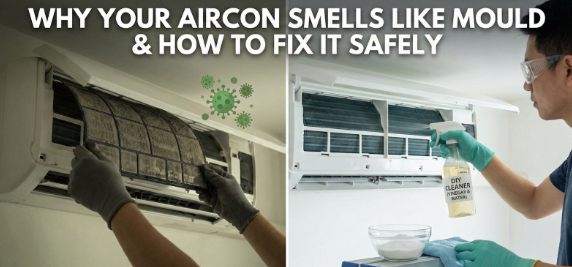
A clear guide explaining why your air conditioner smells like mould, what causes it, and how to safely fix and prevent mould growth inside your split system.
If your aircon blows air that smells musty, damp, sour, or “old gym bag” like, you’re not imagining it. That smell is almost always mould inside the system.
Brisbane’s humidity makes this extremely common.
Any moisture trapped inside your AC creates the perfect environment for mould and bacteria to grow, and every time you turn it on, that contaminated air blows into your home.
Here’s what causes it, and more importantly, how to fix it safely.
1. Moisture Trapped Inside the Indoor Unit (Most Common Cause)
Your aircon removes humidity from the air. When everything works properly, moisture drains out through the condensate drain.
But when it doesn’t, moisture becomes trapped inside, leading to mould on:
Coils
Filters
Fan barrel
Plastic housing
Drain tray
What causes moisture buildup:
✔ Blocked drain line
✔ Poor airflow
✔ Dirty coils
✔ Incorrect installation
✔ High humidity running hours
This is the number one cause of mould smell in Brisbane homes.
2. Dirty or Neglected Filters
Filters trap dust, pollen, skin cells, and debris.
When they become clogged, they stay damp, and damp organic material is prime mould fuel.
Signs this is the problem:
Air smells musty the moment you turn the AC on
Airflow is noticeably weak
Filters look grey, fuzzy, or slimy
Cleaning your filters regularly prevents half of all mould smell problems.
3. Mould on the Fan Barrel (The Hidden Problem Most People Miss)
Even if your filters look clean, the fan barrel inside the AC can be covered in:
Black mould
Slime
Dust build-up
Bacteria biofilm
This part spins constantly and blows contaminated particles directly into your room.
Warning:
This cannot be cleaned properly without opening the unit. Usually done during a professional deep clean.
4. Blocked or Partially Clogged Drain Line
If the drain line becomes blocked, water backs up into:
The drain tray
The coils
The fan area
Stagnant water = mould growth.
This is why some ACs smell mouldy and also drip water indoors.
5. Not Using the AC Regularly
When an AC sits unused for long periods, especially during humid weeks, moisture doesn’t evaporate and mould develops faster.
You might notice the smell only when you turn it back on after weeks or months.
6. Dirty Evaporator Coils
Coils collect fine dust, oils, and moisture.
When dirty, they:
Trap water
Grow mould
Spread odours
Reduce cooling efficiency
Dirty coils also force the AC to work harder, raising your power bill.
7. Contaminated Outdoor Air Being Pulled In
Sometimes the system pulls in odours from:
Damp outdoor walls
Mouldy gardens
Water-damaged areas near the installation
Blocked weep holes
In this case, the unit itself may not be contaminated, the intake air is.
Is a Mouldy Aircon Dangerous?
It can be.
Mould spores circulating in your home may trigger:
Headaches
Respiratory irritation
Asthma flare-ups
Allergy symptoms
Fatigue
Musty smell lingering on clothes
If the smell is strong, the mould growth is usually advanced.
How to Fix a Mouldy-Smelling Aircon Safely
1. Clean or Replace Your Filters
This is step one and should be done every 2–3 months.
2. Run the AC in “Dry” Mode
This helps evaporate moisture inside the system.
3. Check for Water Leaks or Blocked Drains
A blocked drain line needs cleaning before mould returns.
4. Wipe Only What You Can Safely Reach
Surface-level dust can be cleaned, but do not spray chemicals inside the unit. It can damage coils or electronics.
5. Book a Professional Deep Clean if:
The smell is strong
Filters and drains are clean but the smell persists
The AC hasn’t been cleaned in over 12 months
You see visible black mould inside the unit
A proper clean includes:
✔ Coil pressure wash (safe low-pressure)
✔ Fan barrel removal & cleaning
✔ Drain tray sanitisation
✔ Drain line flush
✔ Internal mould treatment
✔ Housing deep clean
This is the only way to remove mould that’s inside the fan and coil area.
Final Word: A Mouldy Aircon Isn’t “Normal” It’s a Sign Something’s Wrong
Mould smells mean moisture is trapped somewhere inside your AC.
Leaving it untreated will only make the smell worse, and can shorten the life of your system.
👉 If your aircon smells like mould, it’s time for a proper clean or inspection.
Keeping your AC clean keeps your home healthy and your system running efficiently.